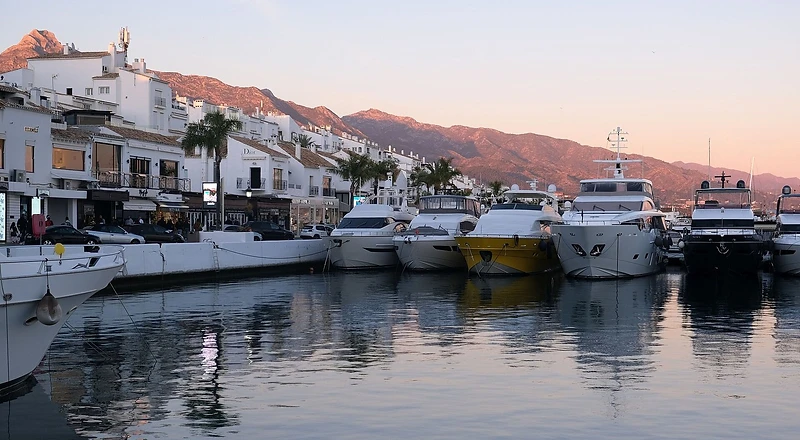
Al-Assad Money Trail: 77 Million Euros and a Marbella Empire
A leak of Deutsche Bank documents shows 7,944 transactions worth 77.2 million euros linked to Rifaat al-Assad, the man who owned the Benabola complex in Puerto Banus and 3,300 hectares in Benahavis.
A leak of internal banking documents has put the Costa del Sol back at the centre of one of Europe's most closely watched money-laundering stories. The records, obtained as part of the Inside Deutsche Bank investigation, show that Germany's largest bank processed 7,944 transactions totalling 77.2 million euros connected to Rifaat al-Assad, the uncle of the former Syrian president and for three decades one of the largest private owners of property in Marbella and Puerto Banús.
The transactions were recorded between May 2013 and July 2020, according to a legal document citing an internal bank report. The bank's review covered payments processed through its correspondent banking relationships between January 2006 and January 2021. Al-Assad died in the United Arab Emirates on 21 January 2026 at the age of 88.
What the documents show
The Inside Deutsche Bank project describes itself as the largest single leak of banking documents in history. It was coordinated by the Barracuda network, with technical support from Germany's Data and Research Centre, and brought together more than 230 journalists from over 50 outlets in more than 60 countries. The material was obtained by journalists Josy Joseph and Khadija Sharife.
According to the reporting, the internal investigation at the bank's Frankfurt branch was opened in 2020, prompted by French criminal proceedings against al-Assad. The records also show transfers worth 5.9 million euros to individuals whose names matched those of his relatives. German financial regulators fined the bank 7 million euros in July 2022 for delays in reporting suspicious transactions.
William Bourdon, founder of the French anti-corruption organisation Sherpa, told the investigating outlet that there was good reason to believe the bank could bear responsibility for remaining silent and failing to report these flows to regulators or prosecutors, and that waiting until a criminal conviction before opening an internal investigation made the reputational damage worse rather than smaller.
The Marbella estate
The Spanish side of the story dates from April 2017, when the Guardia Civil raided properties linked to al-Assad and his family on the instructions of the Audiencia Nacional. The investigating judge ordered the seizure of more than 500 properties, with Spanish courts putting the portfolio at around 700 million euros at the time.
The core of the estate was the Benabola complex in Puerto Banús: 92 apartments, 244 parking spaces, commercial premises and restaurants in one of the most valuable positions on the coast. The portfolio also included a finca in El Ancón and, most significantly, a plot of roughly 33 million square metres in Benahavís, known locally as La Máquina, where the family had planned a development on a scale never built on the Costa del Sol.
That Benahavís project never happened. A long legal battle with the regional government of Andalucía over planning classification blocked it, and the land stayed as it was: largely undeveloped hillside between Marbella, Estepona and the inland villages.
How the Spanish case ended
In May 2025 the Audiencia Nacional suspended the trial of al-Assad's relatives and declared that it was not competent to hear the case, sending the matter to the courts in Málaga. The prosecution had alleged a family criminal structure built to launder more than 700 million euros through a network of opaque companies, and had accused eight relatives. The defendants denied the allegations.
It is important to state plainly what Spanish justice decided and what it did not. Rifaat al-Assad was never convicted in Spain. The case against him and his family ended on procedural grounds, not with a finding of innocence or guilt on the money-laundering charges. The assets seized in 2017 became a matter for the courts in Málaga, and their final destination has not been resolved publicly.
France moved further and faster. A French court sentenced al-Assad in 2020 to four years in prison for financial offences committed between 1996 and 2016, and ordered the confiscation of his French assets together with a London property valued at around 29 million euros. A further ruling in 2021 dealt with money laundering and tax evasion linked to a property empire of roughly 90 million euros. In July 2026, France and Syria signed an agreement to return looted assets, with around 51 million euros earmarked for repatriation.
Why it matters for the coast
The Costa del Sol has spent three decades building an international market on the promise that title is clean and money is welcome. Cases like this one are the reason international buyers now ask different questions than they did in the 1990s, and why Spanish notaries, banks and lawyers have tightened source-of-funds checks on any purchase above a few hundred thousand euros.
The reporting on the banking leak also points to Gibraltar as one of the jurisdictions through which money linked to the family moved. That is not a revelation to anyone who works in the property market here: the Rock has been a standard layer in the ownership structures of prime Marbella real estate since the 1980s, and the paperwork that goes with it is one reason due diligence on a luxury purchase in this region takes longer than buyers expect.
For the market itself, the practical consequence is continuity rather than disruption. The Benabola apartments are occupied and trading, the Puerto Banús commercial units are let, and the Benahavís land remains undeveloped. What has changed is the record: the financial trail behind one of the coast's biggest private portfolios is now documented in a way it was not before, and the institutions that processed it are named.
What happens next
The Syrian government has been pressing for the return of assets held abroad, and the French agreement of July 2026 is the first concrete result. The Spanish file, transferred to Málaga, concerns the relatives rather than the deceased patriarch, and it is not clear whether the seizure of the 2017 portfolio will be lifted, maintained or converted into a restitution process.
For buyers and owners on the Costa del Sol, the case is a reminder of something the market prefers to forget in a good year: prime property here has always attracted capital of every origin, and the difference between a clean purchase and a complicated one is almost never the price. It is the paperwork behind it.
The man behind the portfolio
Rifaat al-Assad was the younger brother of Hafez al-Assad and uncle of Bashar al-Assad, and for a period one of the most feared men in Syria. He commanded the Defence Companies, a paramilitary force at the centre of the 1982 crackdown on Hama in which up to 40,000 civilians were killed, and he served as vice president. He left Syria in 1984 after a failed power struggle with his brother and spent the rest of his life in exile, mostly in Europe.
According to the Spanish investigation, he arrived with money. The case files put the amount handed to him on departure at around 300 million dollars of public funds, and the years that followed were spent converting that capital into property in France, Britain and Spain. On the Costa del Sol the result was a portfolio of a kind rarely seen: an entire block of Puerto Banús, a finca, restaurants, garages and a plot of land in Benahavís large enough to hold a new town.
How the structure worked
Prosecutors in Spain described a family operation rather than a single owner: companies registered in several jurisdictions, properties held through intermediaries, and accounts routed across borders so that no single bank saw the whole picture. That is the pattern the banking leak now documents from the other side of the counter.
The Deutsche Bank figures are a useful illustration of how modern laundering avoids the single large transfer. The 7,944 transactions identified total 77.2 million euros across roughly seven years, which works out at an average of just under 10,000 euros per payment. Payments of that size do not trigger automatic review in most institutions, and in correspondent banking, where the bank is processing a payment on behalf of another institution rather than serving the client directly, the visibility is lower still.
The reporting also records 5.9 million euros transferred to individuals whose names matched those of al-Assad's relatives, which is the point at which a bank has both the name and the pattern in front of it. The German regulator's decision to fine the bank 7 million euros in 2022 for delays in reporting suspicious transactions is separate from the al-Assad case, but it points at the same weakness: the detection happened late.
The scale of the Spanish file
The numbers in the Spanish proceedings are worth setting out because they explain why the case mattered beyond Marbella. The 2017 raid covered more than 500 properties. Court documents cited 503 properties in the family portfolio, and later reporting referred to 507. The seized assets were valued at close to 700 million euros, or about 735 million dollars at the exchange rate of the time.
Within that total, the Benabola complex is the piece everyone in Puerto Banús knows. Ninety-two apartments, 244 parking spaces, commercial premises and restaurants in a single front-line position. It is the kind of asset that rarely comes to market and almost never as one block.
The Benahavís land is the more interesting story for anyone who follows planning on this coast. Thirty-three million square metres is roughly 3,300 hectares, an area larger than many municipalities. The family's plan for it, reported at the time of the raids, was a development on the scale of a small city. Andalucía's planning rules, and a legal dispute over how the land was classified, stopped it. The hillside is still hillside.
Timeline
1984: Rifaat al-Assad leaves Syria after a failed power struggle with his brother and begins his exile in Europe.
1996 to 2016: the period covered by the French financial offences for which he was later convicted.
April 2017: the Guardia Civil raids properties in Marbella and Puerto Banús; the Audiencia Nacional orders the seizure of more than 500 properties.
2019: the Audiencia Nacional concludes that he should stand trial in Spain for money laundering.
2020: a French court sentences him to four years and orders the confiscation of French assets and a London property; Deutsche Bank opens an internal investigation in Frankfurt.
2021: a further French ruling covers money laundering and tax evasion linked to a property empire of about 90 million euros.
July 2022: German regulators fine Deutsche Bank 7 million euros over delays in reporting suspicious transactions.
May 2025: the Audiencia Nacional declares itself not competent and suspends the trial of his relatives, sending the case to Málaga.
21 January 2026: Rifaat al-Assad dies in the United Arab Emirates at the age of 88.
July 2026: France and Syria sign an agreement on the return of looted assets, with around 51 million euros to be repatriated.
November 2026: the Inside Deutsche Bank leak documents 7,944 transactions totalling 77.2 million euros linked to him.
Sources
Inside Deutsche Bank investigation and the Daraj reporting on the bank's internal review, November 2026. Spanish court reporting on the 2017 seizure and the 2025 Audiencia Nacional decision from Agencia EFE, El País, ABC and Cadena SER. French criminal proceedings and the 2026 repatriation agreement as reported by international agencies. Photographs of Puerto Banús: Wikimedia Commons contributors (CC BY-SA 2.0, 3.0 and 4.0, and CC0).
Related news

La Bajadilla: Marbella's 200m Euro Marina Clears Final Hurdle
Marbella's La Bajadilla marina is finally going ahead: more than 200 million euros, 750 berths and space for yachts of up to 70 metres from 2027.

Marbella Christmas 2026: Full Lights and Events Guide
Marbella's Christmas programme runs from 28 November to 5 January, with a new Advent calendar in the old town, a bigger Santa house in San Pedro and Estrella Morente opening the lights.


Marbella Crime Wave: Vox Demands More Police After Stabbings
Several stabbings and a shooting in the El Ángel area have put Marbella's policing levels at the centre of a fierce political row, with Vox demanding more National Police.
Free Guide: Buying Property in Spain 2026
A step-by-step guide for international buyers — from NIE to the notary.
We'll send you the guide link by email too. No spam — your details stay with Marbella New Homes.