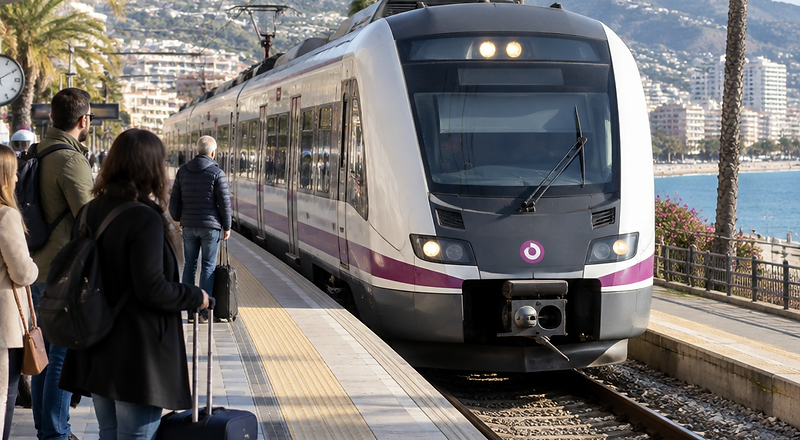
Benalmadena Train Strike Disrupts C-1 Malaga Fuengirola Line
Benalmadena train strike: Cercanias drivers stoppages hit the C-1 line between Malaga and Fuengirola, with minimum services of 75 percent at peak times.
Commuters in Benalmadena have faced an uncomfortable start to November after a strike by train drivers disrupted the C-1 Cercanías line between Malaga and Fuengirola, the railway artery that carries thousands of residents along the coast every day. The stoppages, called for the 10th, 11th and 12th of the month, hit stations across the western Costa del Sol, and Benalmadena-Arroyo de la Miel, one of the busiest stops on the entire route, felt the impact as sharply as anywhere.
How the strike unfolded
Tuesday the 10th brought a full twenty-four-hour stoppage, the most disruptive single day on the calendar. The remaining days were scheduled as partial stoppages, with trains withdrawn at certain hours rather than across whole shifts. Under the minimum service levels ordered by the authorities, operators had to keep seventy-five per cent of scheduled trains running during peak periods and fifty per cent for the rest of the day. Those percentages sound generous until you stand on a platform at rush hour, when every cancelled train is packed into the one that survives.
A last-minute reprieve
On the eve of the third planned round of action, the drivers' union announced it was postponing the stoppage pencilled in for Thursday the 12th and moving it to the 23rd of November. For passengers that meant a breathing space, though the network was still absorbing the delays and cancellations left behind by the earlier days. Recovery on a line with tight headways is rarely instant, and on the morning the postponement was confirmed many travellers were still checking departure boards with understandable suspicion.
What it means for Benalmadena
Few towns depend on the C-1 as much as Benalmadena does. The line links the resort with Torremolinos and Malaga to the east, and with Fuengirola to the west, and it is the daily route to work, to school and to hospital appointments for thousands of households. It also serves Malaga Airport, the main gateway for the international visitors who fill the town's hotels and apartments, so disruption ripples straight into the tourism economy even in a quieter season. When the trains thin out, the pressure lands on local buses and on the coastal road, which is rarely free-flowing at the best of times.
Practical advice for passengers
Anyone travelling over the coming days should build in extra time and check timetables before leaving the house, because minimum service levels can shift confirmed departures around the clock. Allow more time for airport journeys in particular, and expect trains that do run to be fuller than usual, with the crowding that always follows a reduced timetable. Keeping an eye on official service announcements is worthwhile too, since further dates of action remain on the table and advance notice has so far been the one thing passengers could rely on.
Why these disputes drag on
Rail disputes in Spain tend to unfold like this: a union calls staggered stoppages designed to be noticed without shutting the country down entirely, the government sets minimum service levels to blunt the impact, and the two sides continue negotiating in between rounds. Commuters are effectively the negotiating table. Whether the postponed stoppage on the 23rd actually goes ahead will depend on how those conversations develop over the next week and a half.
Looking ahead
The good news for Benalmadena is that the immediate pressure has eased, with Thursday's action called off and the line steadily returning to its normal rhythm. The sharper worry is that another day of disruption is already scheduled for late November, just as the festive season begins to build momentum and leisure travel picks up along the coast. Workers who ride the C-1 daily, hotel staff, students and day-trippers alike, will be hoping that the extra notice and the next round of talks finally deliver a settlement rather than another week of staring at departure boards.
Related news


Torrox Christmas Lights: Two Million Bulbs Light the Coast
Torrox and El Morche have switched on more than two million Christmas lights along twenty kilometres of streets, one of the earliest festive displays on the Costa del Sol.


Nerja Cave Festival Returns in 2027 After Legal Deadlock
The Nerja Cave Festival returns in 2027 after a two-year legal deadlock, with Spain's contract appeals tribunal clearing up to twelve outdoor shows at the cave.


Sotogrande Schools Reopen After Storm Charles Shutdown
Schools in Sotogrande and across the Campo de Gibraltar are back in class after Storm Charles suspended in-person teaching on Wednesday. What happened, and how families can be ready for the next orange alert.
Free Guide: Buying Property in Spain 2026
A step-by-step guide for international buyers — from NIE to the notary.
We'll send you the guide link by email too. No spam — your details stay with Marbella New Homes.