Casares to Name Manu Sánchez Adopted Son of Town
Casares will name Manu Sánchez Hijo Adoptivo of the town, honouring his defence of Blas Infante's legacy, with the ceremony set for Semana de Andalucía.
Casares will name the Andalusian comedian and television presenter Manu Sánchez as Hijo Adoptivo of the municipality, an honorary title the town council announced on 26 November 2026. The distinction recognises his commitment to Andalucía and the personal link he has built with Casares, and the ceremony is expected to take place during the next Semana de Andalucía, the week of institutional and cultural events that surrounds the region's official day at the end of February.
The title of Hijo Adoptivo is not given lightly in Spanish municipal practice. It is voted through a full council session and reserved for people who were not born in the town but who have earned its recognition through sustained service, cultural contribution or an exceptional public record. In a municipality the size of Casares, where the administrative machine is small and every honour carries the weight of a village that knows its own history, the decision tends to say something about how the town sees itself as much as about the person receiving it.
In this case the connection runs through Blas Infante, the writer and politician regarded as the father of Andalusian identity, who was born in Casares in 1885 and executed in 1936. The council's announcement frames the honour around Sánchez's work in defence of that legacy, and the timing is deliberate: Semana de Andalucía is precisely when the region's institutions turn to the question of what Andalusian identity means now, rather than only what it meant a century ago.
For Casares itself, the announcement lands in the middle of an unusually busy period. The municipality was admitted to the Pueblos Mágicos de España network with the 2027 designation, a recognition that puts it alongside a small group of towns selected for heritage and landscape rather than for visitor volume, and it has been working for several years on the balance between the whitewashed hilltop village that draws day-trippers and the coastal strip at Casares Costa, where most of the residential development and most of the foreign buyer interest sits.
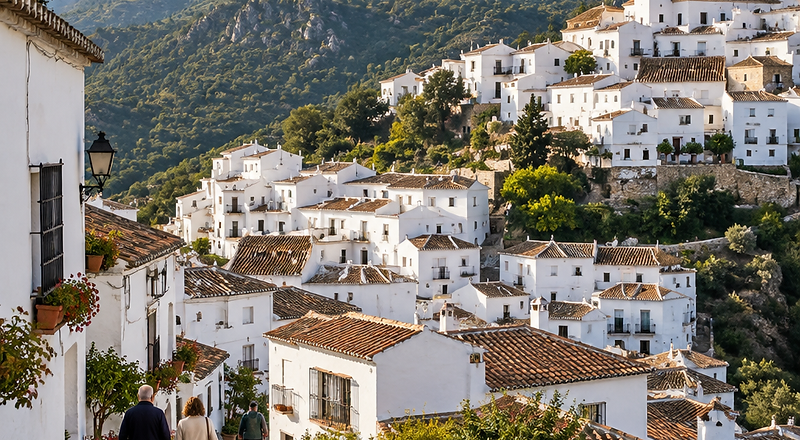
That split matters when a town starts collecting cultural distinctions. The pueblo itself is a conservation exercise: narrow streets, white facades, a church tower visible from the A-377, and a castle whose restoration has been discussed for years. The coast is a different economy altogether, built around golf, second homes and the stretch of shoreline that runs towards Estepona and Manilva. Anything that raises the profile of the historic centre tends to feed directly into short-term rental demand in the village, and indirectly into the resale value of properties that can claim a view of it.
There is also a quieter effect that matters to anyone who lives in Casares year round. Municipal honours of this kind are cheap to award and expensive to follow up, because attention arrives without infrastructure. The town has spent recent years trying to convert day visitors into overnight stays, and a higher public profile makes that harder rather than easier if parking, access and services do not keep pace. The council's own housing and urban planning work over the next few years will determine whether the distinction translates into anything more durable than a good photograph.
For residents, the practical consequence is a date in the calendar. Semana de Andalucía brings a plenary session, a formal act and, in towns that take it seriously, a programme of cultural events around it. Casares has generally used the week to combine institutional ceremony with local history, and the addition of a public figure with a television audience is likely to widen that audience considerably.
Manu Sánchez, for his part, is one of the better known Andalusian voices on Spanish television, with a career built on humour that leans heavily on the region's own idiom. Being named an adopted son of Blas Infante's birthplace is, in the small world of Andalusian cultural politics, about as pointed a compliment as the region offers. Whether it brings visitors to a village of steep streets and limited parking is a separate question, and one the town will have to answer in the seasons that follow.
Casares town council has not yet published the exact date of the ceremony, which will fall within Semana de Andalucía in late February 2027.
Related news


Selling a Property in Spain: Costs and Taxes in 2026
What a sale really costs on the Costa del Sol in 2026: agency commission, energy certificate, plusvalía, the 19% or 24% non-resident capital gains rate, the 3% retention and how to claim it back.
Buying a Car in Spain: The Costa del Sol Guide
Buying a car in Spain on the Costa del Sol: ITP at 4 percent in Andalucía, 55.70 euros for the DGT transfer, the ITV calendar, insurance, and the full cost of a UK import.

Costa del Sol Long-Term Rentals: Contract, Deposit, Rent Rises
Long-term lets on the Costa del Sol run on five or seven year terms, a one-month deposit and the IRAV index. What changed in Andalusia in 2026 and what you pay on day one.
Free Guide: Buying Property in Spain 2026
A step-by-step guide for international buyers — from NIE to the notary.
We'll send you the guide link by email too. No spam — your details stay with Marbella New Homes.