Costa del Sol 25N: Marches and a Rise in VioGén Cases
Costa del Sol municipalities marked 25N with marches and manifestos, while provincial figures show close to seven women a day entering the VioGén system in 2026.
The Costa del Sol marked 25 November with institutional acts, marches and readings of manifestos in municipalities along the coast, in a province where the official caseload keeps climbing while the day itself has become a fixture in every town hall calendar.
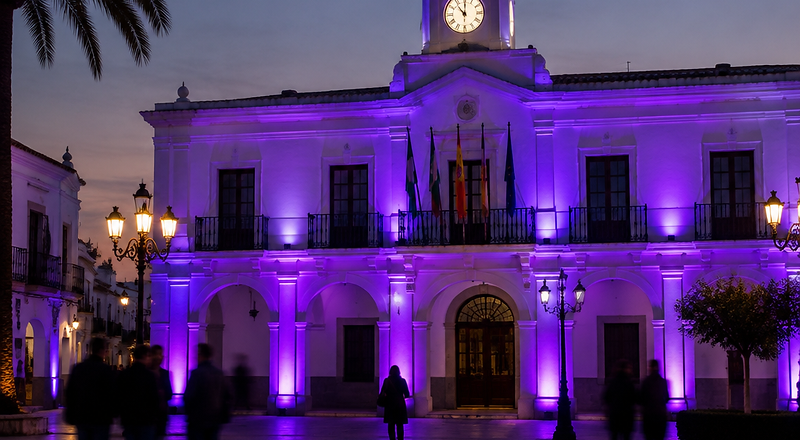
The date is the International Day for the Elimination of Violence against Women. In Málaga capital a demonstration was called with a published timetable and route, and town halls across the province organised their own events, most of them in the morning, several of them in the main square rather than inside the building. The format has settled over the years: a manifesto read aloud, a minute of silence, a banner on the balcony, and then the ordinary business of the day resumes.
The numbers behind the ceremony are less settled. In the province of Málaga, close to seven women a day entered the VioGén tracking system during 2026, with 2,087 new victims recorded up to the end of October. The province now carries the largest historical total in Andalucía, with 48,134 files opened since the system began. The cases classified as high risk have also risen this year, which is the figure that matters most to the police units that manage them, because high risk means active monitoring, patrols and court coordination.
Divide 2,087 by the ten months to October and you get 6.9 a day. That is the arithmetic behind the phrase almost seven a day, and it is worth doing the division yourself rather than accepting the phrase, because a daily rate sounds abstract until it is applied to a town of twenty thousand people.
For the municipalities on this coast, the practical work sits in three places. The first is the local police protocol, which determines how quickly a patrol arrives and whether an officer is trained to read the situation. The second is the social services office, which is where a woman with no income, no separate bank account and children in the local school actually gets help, and where the waiting list is the constraint. The third is housing. A refuge bed in Málaga is not much use to someone in Manilva if the journey takes two hours and she has to leave a job to make it.
That last point is the one the coast rarely discusses on 25 November. This is a province of high rents, seasonal work and a large foreign resident population, and all three complicate the standard response. A woman on a seasonal hospitality contract has no payslip history to rent a flat quickly. A foreign resident may have limited Spanish and no family network within a thousand kilometres. A town that empties in February has fewer eyes on the street in the months when nobody is watching.
The manifestos read on 25 November tend to promise education, prevention and coordination. Those are the right words and they are also the easiest to write. The measurable commitments are narrower: whether a town hall funds a dedicated equality officer rather than adding the brief to an already overloaded councillor, whether the local police have a specialist unit, and whether the municipal budget line for victim support grew or shrank this year. Most of the coast will publish that detail in December, when the 2027 budgets come out.
There is a version of this day that is only ceremonial, and a version where it is a checkpoint. The difference is whether anyone returns to the numbers in February. On the coast, where the population roughly doubles in August and the support services do not, the honest reading of 25 November 2026 is that awareness is now universal and capacity is not. Nearly seven women a day in a single province is not a campaign problem. It is a staffing and housing problem wearing a purple ribbon for one morning a year.
Related news


Selling a Property in Spain: Costs and Taxes in 2026
What a sale really costs on the Costa del Sol in 2026: agency commission, energy certificate, plusvalía, the 19% or 24% non-resident capital gains rate, the 3% retention and how to claim it back.
Buying a Car in Spain: The Costa del Sol Guide
Buying a car in Spain on the Costa del Sol: ITP at 4 percent in Andalucía, 55.70 euros for the DGT transfer, the ITV calendar, insurance, and the full cost of a UK import.


Costa del Sol Long-Term Rentals: Contract, Deposit, Rent Rises
Long-term lets on the Costa del Sol run on five or seven year terms, a one-month deposit and the IRAV index. What changed in Andalusia in 2026 and what you pay on day one.
Free Guide: Buying Property in Spain 2026
A step-by-step guide for international buyers — from NIE to the notary.
We'll send you the guide link by email too. No spam — your details stay with Marbella New Homes.