
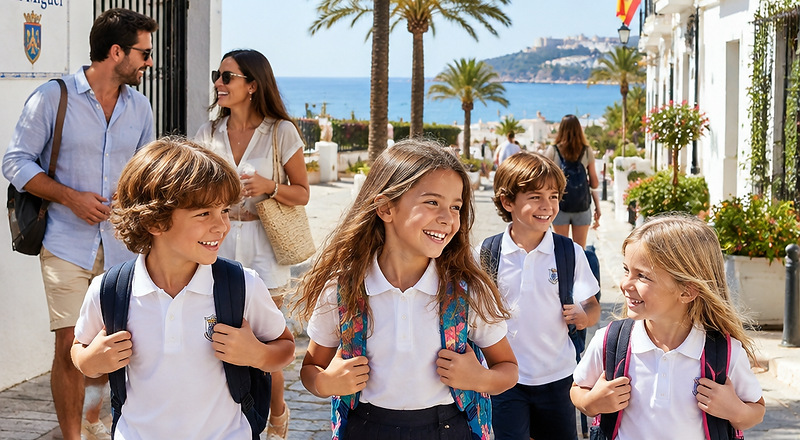
Costa del Sol Schools Guide: Public and International Choices
How to get your child into a Costa del Sol school: the March admission window, the documents you need, the points system, and what international school fees cost for 2026/27.
Choosing a school is the decision that shapes a family's whole move, and the good news is that the Costa del Sol is one of the easiest places in Spain to get it right. The province of Malaga has everything from free public schools taught in Spanish to British, IB, German, French and Scandinavian schools along the coast. The catch is timing: the public admission window only opens once a year, and if you miss it your options narrow fast. Here is how the system works and what it costs, based on the rules and fees in force for the 2026/27 school year.
THE THREE TYPES OF SCHOOL IN SPAIN
Spanish education splits into three blocks, and every town on the coast offers all three. Public schools (colegios publicos) are fully funded by the state and free, including textbooks in primary under the regional scheme, though you pay for meals, uniforms where required and after-school activities. Concertados (semi-private schools) are private in name but heavily subsidised, so fees sit between roughly 30 and 150 euros a month, and they follow the Spanish curriculum with a stronger record of English than most public schools. Private international schools charge full fees, teach in English or another foreign language, and everything else is up to each school.
Compulsory schooling runs from age 6 (Primaria, six years) through ESO (four years of secondary, ages 12 to 16). Before that, Infantil covers ages 3 to 6: the second Infantil cycle, from age 3, is free in the public system and treated as part of the ordinary admission process. Babies and toddlers from 0 to 3 go to nursery (guarderia), which is a separate process with its own admission round.
PUBLIC AND CONCERTADO SCHOOLS: THE MARCH WINDOW
If you want a place in a public or concertado school, you apply through the Andalusian Schooling Portal (the Escolarizacion section of the regional education website) during the ordinary admission process. For the 2026/27 school year the application window ran from 1 to 31 March 2026, with provisional points published on 20 April, the public tie-break lottery held on 13 May and final lists posted a few days later. The same calendar is announced each winter, so if you are aiming for September 2027, plan on applying during March 2027. Applications are free, online, and you can list several schools in order of preference.
Because demand varies hugely by town, the Junta publishes live data on how many places are free at each school before you apply, which is worth checking carefully. A rural public school in the Axarquia may have free desks all summer, while popular concertados in Marbella, Fuengirola or Benalmadena fill every place in the first round.
HOW THE POINTS SYSTEM DECIDES WHO GETS IN
Places are awarded by a points scale called baremacion, and almost all of it is within your control. Highest scores go to siblings already enrolled at the school, how close you live (the catchment is drawn around the school, and the empadronamiento certificate is how you prove it), and parental work or address within the catchment. This is why getting on the padron in your chosen town before the March window matters so much: without it your address score drops and you compete for the leftover places only. After the 31 March deadline, schools run an extraordinary process over the summer for late arrivals, moving families and returning expats, and this continues into the school year itself. You will get a place somewhere in your municipality, but in March you compete for your first choice; in July you take what is left.
DOCUMENTS YOU NEED TO ENROL
The checklist is the same whether your child is Spanish or foreign-born, but foreign documents must be legalised and translated. You will need the application form from the portal; proof of address for you and the child, almost always the empadronamiento certificate; your own ID, NIE or TIE plus the child's passport or residence document; the child's birth certificate (apostilled and sworn-translated if issued abroad); the child's health card or vaccination record from your paediatrician; and, where relevant, report cards from the previous school for mid-year transfers. Non-Spanish reports need a simple translation for the school to set the correct year group. For a mid-year move, you do not go through the online lottery at all: contact the school direct, or the municipal education office, which places arriving children in whatever the local school has free.
INTERNATIONAL SCHOOLS: WHAT THEY COST
The coast from Malaga city to Sotogrande has one of the densest clusters of international schools in Europe, including long-established British schools in Marbella and Estepona, IB schools, a German school serving Malaga city and the eastern coast, a French lycee and Swedish and Finnish schools in Fuengirola and Marbella that have grown with the Scandinavian community. For the 2026/27 year, annual published tuition at the most-quoted schools on the coast starts around 5,000 to 8,000 euros in the early years and generally runs between roughly 8,000 and 13,000 euros per year in primary, rising to about 13,000 to 20,000 euros in senior years, especially where the IB Diploma or British A-levels are taught. Published fee tables differ because schools bundle costs differently, so treat these as planning ranges and always request the current fee sheet.
Tuition is not the whole bill. Nearly all international schools charge a one-off enrolment or registration fee (commonly several hundred to a few thousand euros, sometimes refundable), a deposit that is offset against the final year's fees, plus school bus routes, lunch, uniform and exam fees such as IGCSE or IB entries. As a working budget, families commonly plan for total annual costs around 1,000 to 3,000 euros above the headline tuition. Discounted and scholarship places exist, especially for siblings, and some schools soften fees for families paying early or in one instalment.
Admission to international schools is rolling, not one window a year: you contact the school directly, submit previous school reports, the child may sit light maths, English and Spanish placement tests, and places are offered as long as the class has room. Year groups fill months ahead in the most sought-after schools, so families relocating for September should start enquiries in the spring, and mid-year transfers are routine for families facing January moves.
THE SCHOOL YEAR AND THE SCHOOL DAY
Andalusia sets its school calendar a year in advance, and for 2026/27 classes begin in the first half of September (around 9 and 10 September 2026 in infant, primary and secondary in Malaga province), with the Christmas break running to early January, a Holy Week holiday that moves with Easter, and the year finishing in late June. Children coming from a country with a different academic rhythm, such as an August-to-June or January-to-December year, should check the June and September dates early, because year-group timing and age cut-offs follow the Spanish calendar. Public schools largely teach mornings until early afternoon with a comedor (school canteen) service at lunch, while concertados and internationals mostly run a longer day, 9am to 4pm or beyond, which matters if both parents work.
HOW TO DECIDE, STEP BY STEP
One: check first what you can walk to. Catchment and the padron drive public admission, so fix your address before the March window opens if you can. Two: list three public or concertado options in order of preference, and rank honestly, since second choices strongly affect your chances in the first round. Three: the fee range limits you more than the map does, so set a budget and request the full fee schedule including bus and meals for the year groups you need. Four: visit open days, and ask about class sizes and the language of instruction, since true English-medium teaching matters more than the marketing. Five: file the online school application between 1 and 31 March, and check the allocated place in May, so you have time to appeal in June if the assignment is not what you wanted.
The education system on the coast works, and half of the process is simply being there on time.
Related news

Empadronamiento Costa del Sol: A Step-by-Step Guide
Empadronamiento Costa del Sol explained: documents, cita previa and renewal rules for Marbella, Mijas, Estepona and Fuengirola.

Costa del Sol Healthcare: Health Card, S1 and Private Cover
Costa del Sol healthcare explained: the Andalusian health card, who is covered, the S1 for UK pensioners, the convenio especial and private insurance.


Driving in Spain for Foreigners: Licence, ITV and Fines
Who can drive in Spain on a foreign licence, when residents must exchange it, how the ITV works, insurance, fines with the 50% discount, points and the 2026 rule changes on the Costa del Sol.
Free Guide: Buying Property in Spain 2026
A step-by-step guide for international buyers — from NIE to the notary.
We'll send you the guide link by email too. No spam — your details stay with Marbella New Homes.