
Estepona Advances Urban Fast-Tracking to Balance Rapid Coastal Growth
Municipal planning reforms and infrastructure upgrades keep Estepona moving forward as residential expansion spreads along the coastline.
Town hall officials in Estepona have spent the autumn months tightening up planning procedures, trimming the time it takes to approve public works and infrastructure permits as the municipality cements its reputation as one of the fastest-growing residential areas on the coast.
Administrative Efficiency Driving Local Development
The changes stem from a reorganisation of the town's planning departments, which now handle applications for public civil works, commercial licences and residential schemes considerably faster than before. Builders and developers working on the Costa del Sol have long complained about planning delays that can stretch projects out for years, so any move to shorten that process tends to get noticed. In Estepona's case, the quicker turnaround has helped keep commercial and civic investment flowing into the town at a pace that compares favourably with some of its neighbours along the coast, where bureaucratic processes remain considerably slower.
That efficiency matters because infrastructure has to arrive alongside private development, not years after it. New boulevard links, underground car parks and improvements to public schools have all been completed in step with residential and commercial building, rather than trailing behind it as often happens elsewhere. For buyers weighing up off-plan purchases, this is a practical consideration: a development sitting in a well-serviced municipal zone, with roads, parking and schools already sorted, carries less risk than one in an area still waiting on basic infrastructure. Specialists such as Marbella New Homes regularly point clients toward these better-serviced zones when assessing new schemes along this stretch of coast.
Expanding the Coastal Promenade Network
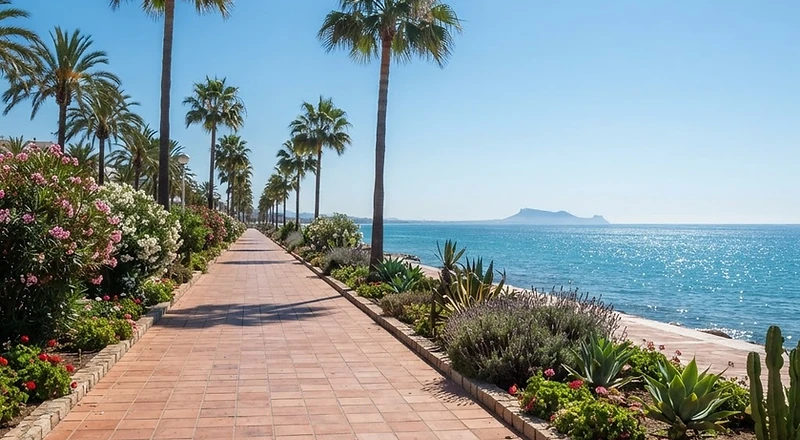
One of the more visible parts of the town's planning agenda is the ongoing extension of the Senda Litoral, the pedestrian walkway that already runs uninterrupted for more than 15 kilometres along Estepona's coastline. It's one of the longest continuous seafront promenades on the Costa del Sol, and council teams are now finishing off connecting footbridges and public plazas designed to link beachfront neighbourhoods that have historically felt cut off from the old town centre.
For residents, this isn't a cosmetic upgrade. Linking outlying beachside suburbs directly to the historic centre on foot or by bike changes daily habits — it means fewer short car journeys for a coffee or a trip to the market, and better access to the seafront for families living further out. It also extends the appeal of areas that previously relied on cars to reach the centre, which has implications for property values in those districts as walkability becomes an increasingly strong selling point for both local buyers and international ones.
Alongside the coastal work, the municipality has been regenerating the old town itself, pairing its traditional flower-decked laneways with newer cultural centres, sports pavilions and the seafront Mirador del Carmen exhibition space. The idea is straightforward: growth on the edges of town shouldn't come at the expense of the historic centre, which remains one of Estepona's main draws for both residents and the steady flow of visitors who come for its Andalusian character.
Balancing Modern Living with Community Character
Estepona's population has shifted considerably over the past decade, with northern European families and international professionals increasingly choosing to settle there year-round rather than treating it purely as a holiday destination. That shift has put pressure on planners to think beyond short-term building targets.
Newly designated development parcels are now subject to stricter environmental standards and larger mandatory green space allocations than in the past. The intention is to stop the town's physical footprint expanding at the cost of the features that attracted people in the first place — tree-lined avenues, maintained public gardens and promenades people can actually walk along. Whether this balance holds as Estepona continues to grow will depend largely on how consistently these standards are applied to the next wave of projects now working their way through the faster planning pipeline.
For homeowners and prospective buyers, the practical upshot is a town where infrastructure, planning rules and lifestyle amenities are, for now, moving broadly in step with one another — something not every municipality on this coastline can currently claim.
Related news

Estepona Advances Coastal Infrastructure and Connectivity with Port Promenade Link
Estepona begins the final structural connection linking its western marina district to the coastal corridor, expanding car-free sea-view walkways for residents.

AP-7 Shooting Near Estepona Triggers High-Level Police Investigation
Spanish authorities launch a manhunt following a daylight firearm incident involving moving vehicles along the western motorway corridor.

Police Launch Investigation After AP-7 Highway Drive-By Shooting Near Estepona
National Police and Guardia Civil have launched an inquiry after shots were fired from a moving vehicle on the AP-7 toll motorway near Estepona.