Estepona Christmas 2026: Fifty Events From 1 December
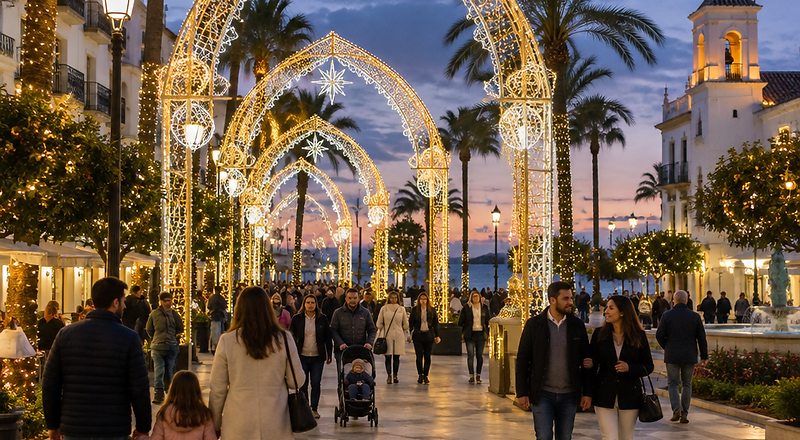
Estepona Christmas 2026 brings around fifty cultural and festive activities, opening with the lights switch-on on 1 December and closing with the Three Kings parade on 5 January.
Estepona has put together a Christmas programme of around fifty cultural, festive and leisure activities, presented by the town council on 26 November 2026. The calendar opens on 1 December with the switching on of the Christmas lights and closes on 5 January with the Cabalgata de Reyes Magos, the Three Kings parade that ends the festive season in almost every Spanish town and, in this case, bookends five weeks of programming.
The five-week span is worth noting. Christmas programming on the Costa del Sol has stretched steadily in recent years, partly because the season now carries real commercial weight beyond tourism: it is when the resident population is at its most stable, when families visit from northern Europe, and when the rental market runs at one of its two annual peaks. A town that fills December and the first week of January with activities is not only decorating itself. It is giving people a reason to stay in the municipality rather than drive to Málaga, Marbella or the shopping centres.
Estepona's approach has followed a pattern the town has refined over more than a decade. Rather than concentrating everything in a single square, the council tends to spread events across the centre and the outlying neighbourhoods, so that the programme reaches residents who would not drive into the old town on a December evening. That distribution is also a quiet piece of urban policy: a town that keeps its streets busy after dark, in winter, with families walking between events, is a town that feels safe and lived in, which is exactly the impression that matters to anyone evaluating it as a place to buy.
The dates also put Estepona slightly behind its neighbours. San Pedro Alcántara switches on its lights on 27 November and Marbella on 28 November, both of them staged as separate evenings rather than one shared municipal event. Starting on 1 December means Estepona opens the season after the first weekend rush, when the first wave of curiosity has passed and the calendar has settled into something closer to routine. For residents that is often the more comfortable option. For businesses in the centre, the earlier switch-ons elsewhere are a reminder that footfall in the first weekend of December is a competitive business across the western Costa del Sol.
For visitors planning around the season, the practical shape of the programme is straightforward. The lights stay on from 1 December to 5 January, so the illuminations themselves can be seen at any point across five weeks. The event programming is concentrated in December, with the final push around the Christmas and New Year weeks, and the Three Kings parade on 5 January is the single busiest night of the whole period, with roads in the centre closed and parking effectively unavailable for several hours before and after.
Anyone renting out property in Estepona should already have the 5 January date blocked in the calendar. It is one of the few nights of the winter when the town centre behaves like August, and guests who arrive expecting to drive to the parade usually end up walking from well outside the centre. The same applies to the switch-on night on 1 December, which historically draws a large crowd to the main streets for the first hour.
The wider point is that Estepona has continued to invest in its public realm through a period when many coastal municipalities pulled back. The town's reputation was built on flowers, pedestrian streets and the long seafront promenade, and the Christmas programme is the winter expression of the same strategy. It does not move prices on its own. But a municipality that keeps its centre presentable, lit and busy in the off season is a municipality that supports the rental income and resale values of the housing stock around it, and buyers who spend December here rather than only in July tend to notice the difference.
The full programme of around fifty activities is published by the town council and runs from 1 December 2026 to 5 January 2027.
Related news


Selling a Property in Spain: Costs and Taxes in 2026
What a sale really costs on the Costa del Sol in 2026: agency commission, energy certificate, plusvalía, the 19% or 24% non-resident capital gains rate, the 3% retention and how to claim it back.
Buying a Car in Spain: The Costa del Sol Guide
Buying a car in Spain on the Costa del Sol: ITP at 4 percent in Andalucía, 55.70 euros for the DGT transfer, the ITV calendar, insurance, and the full cost of a UK import.

Costa del Sol Long-Term Rentals: Contract, Deposit, Rent Rises
Long-term lets on the Costa del Sol run on five or seven year terms, a one-month deposit and the IRAV index. What changed in Andalusia in 2026 and what you pay on day one.
Free Guide: Buying Property in Spain 2026
A step-by-step guide for international buyers — from NIE to the notary.
We'll send you the guide link by email too. No spam — your details stay with Marbella New Homes.