
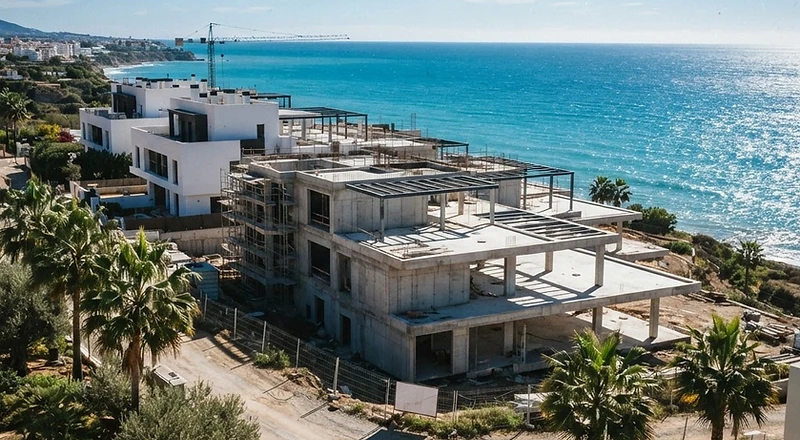
Estepona Off-Plan Sector Accelerates as Foreign Capital Expands
Rapid town hall licensing and substantial municipal upgrades are propelling more than fifty off-plan developments across Estepona this autumn.
Fifty Sites, One Direction of Travel
Walk the back streets behind Estepona's old town this month and you'll count cranes rather than church towers. More than fifty residential developments are under active construction across the municipality, a figure that confirms what agents on the ground have been saying for the past two years: Estepona has become the busiest building site on the western Costa del Sol. For a town once overshadowed by its larger, flashier neighbour Marbella, that's a notable shift in fortunes.
Much of the credit, according to local property professionals, goes to the town hall itself. Mayor José María García Urbano, in office for more than two decades, has pushed through changes designed to cut the bureaucratic delays that have historically slowed Spanish construction projects. Building licences that once sat in drawers for months are now processed faster, and that administrative speed has become a selling point in itself — developers can plan with more certainty, and buyers see fewer delays between groundbreaking and keys-in-hand.
Why Buyers Are Looking Past Marbella
Central Marbella's land bank has been shrinking for years, with little untouched space left near the seafront or golf valley. Estepona, by contrast, still has room to grow, and the town hall's long-running programme of public works — new paving, pedestrianised streets, improved lighting and drainage — has steadily upgraded the urban fabric around the historic centre. Combined with a coastal promenade that now runs for more than 15 kilometres, the town offers buyers a lifestyle proposition that increasingly rivals its neighbour, usually at a lower entry price.
That gap in value is precisely what's drawing reservation numbers up on off-plan schemes. Buyers who've watched Marbella prices climb out of reach are turning west, and developers have responded by launching projects aimed squarely at that overflow demand.
How the Off-Plan Pricing Ladder Works
For many expatriate buyers, purchasing off-plan in Estepona isn't a gamble — it's become a structured investment approach with predictable stages. Prices typically move upward at three distinct points: once the building licence is granted, again when show apartments open to the public, and a final adjustment at project completion. Buyers who commit early, before the first licence-triggered increase, stand to see the clearest capital appreciation over the construction period.
Foreign buyers — particularly from Britain, Scandinavia and central Europe — make up a decisive share of contracts signed on these developments. Many secure units at the lowest foundational pricing tier, then rely on staged payment schedules that spread cost over the build period rather than requiring a lump sum upfront. Crucially, Spanish law requires developers to provide bank guarantees covering deposits paid during construction, meaning committed funds are protected if a project stalls or fails to complete — a safeguard that has given overseas buyers more confidence in a market that, in other countries, might feel riskier.
What Buyers Should Check Before Signing
The pace of building has its own consequences. With dozens of sites competing for the same pool of contractors, finding tier-one builders with strong track records has become harder, and specialists warn that not every developer offers the same financial footing. Consultants including Marbella New Homes recommend that prospective purchasers scrutinise structural warranties and post-completion energy performance certificates before exchanging contracts — details that are easy to overlook amid the excitement of a show-apartment visit, but that matter considerably once the building is occupied and running costs begin.
For residents already living in Estepona, the construction boom brings mixed practical realities: more traffic and noise in the short term, but also improved infrastructure, new amenities and a broader tax base for the municipality to draw on. For homeowners who bought early, rising reservation prices on nearby schemes are generally good news for resale values.
What Comes Next
Handovers on a wave of current projects are pencilled in across 2027 and 2028, meaning the visible construction activity shaping Estepona's skyline today will keep going for several more years yet. Barring a sharp change in financing conditions or planning policy, the town's building boom shows no obvious sign of slowing, and its position as the coast's most active development zone looks set to hold for some time.
Related news

Estepona Advances Coastal Infrastructure and Connectivity with Port Promenade Link
Estepona begins the final structural connection linking its western marina district to the coastal corridor, expanding car-free sea-view walkways for residents.

AP-7 Shooting Near Estepona Triggers High-Level Police Investigation
Spanish authorities launch a manhunt following a daylight firearm incident involving moving vehicles along the western motorway corridor.

Police Launch Investigation After AP-7 Highway Drive-By Shooting Near Estepona
National Police and Guardia Civil have launched an inquiry after shots were fired from a moving vehicle on the AP-7 toll motorway near Estepona.