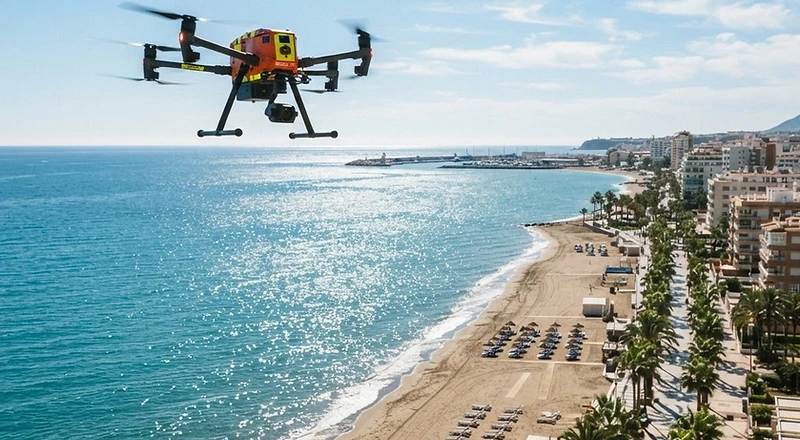
Fuengirola Expands Coastal Drone Lifeguard Fleet Following Historic Rescue Success
Fuengirola Town Hall commissions expanded autonomous sea rescue drones along its seven-kilometre shoreline after pioneering life-saving trials this summer.
Council Signs Off on Year-Round Drone Fleet
Fuengirola Town Council has ratified an expanded contract that will see high-speed autonomous rescue drones deployed across all seven kilometres of municipal beaches, all year round. The decision was taken during this week's coastal security plenary meeting and follows trials earlier in the year that reportedly halved swimmer response times during the busiest weeks of summer.
For a resort town that lives and dies by its beach season, the move signals a shift from seasonal lifeguard cover towards a permanent, technology-led safety net. Fuengirola draws enormous numbers of British, Irish, German and Scandinavian residents and holidaymakers who use the coastline well beyond the traditional June-to-September window, and council officials argue the old model of scaling back lifeguard provision once the tourist crowds thin out no longer reflects how the beaches are actually used.
Cutting Response Times to Seconds
The aircraft are operated by trained local maritime civil protection officers based along the Paseo Marítimo and carry dual inflatable life-vests alongside high-definition thermal imaging cameras. According to the council, a drone can reach a struggling swimmer up to 400 metres offshore within 45 seconds, considerably faster than a jet ski trying to weave through crowded bathing lanes. Once over a casualty, the drone drops a self-inflating buoyancy ring and transmits precise GPS coordinates to waterborne rescue teams, cutting out the guesswork that normally slows down open-water rescues.
Town Hall records confirm the system has carried out four critical interventions since June, including the rescue of elderly swimmers caught in sudden rip currents near the Los Boliches breakwaters — a stretch of coast known locally for unpredictable currents when the wind shifts. Those documented saves appear to be the trigger for the council's decision to commit to the technology permanently rather than treat it as a summer pilot scheme.
Six Permanent Stations Along the Coast
Under the new phase, the fleet will expand to six permanent standby units mounted on elevated telemetry masts at Carvajal, Castillo Sohail and Torreblanca — three of the busiest and most exposed points along Fuengirola's shoreline. Positioning the masts at these locations is intended to give continuous coverage of the municipality's full seven kilometres of sand, rather than relying on drones being physically moved between hotspots as incidents develop.
"Coastal safety cannot pause simply because summer ends; our autumn and winter waters are used daily by foreign residents, surfers and open-water swimmers," council spokespeople said during a demonstration held on Friday. Fuengirola and neighbouring Mijas are understood to be aligning their coastal safety infrastructure with wider efforts to bring beach provision up to international tourism standards, a response in part to the sheer number of Northern European residents who swim through the Costa del Sol's mild autumn and early-winter months.
What the €240,000 Investment Covers
The €240,000 package funds more than the drones themselves. It also introduces real-time jellyfish tracking and water quality monitoring sensors, with data feeding directly into the municipal beach information app. Residents and visitors will be able to check swimming conditions, sea temperature and UV index in both English and Spanish before heading down to the sand — useful for anyone planning an early-morning swim or deciding whether the children should be in the water at all that day.
What It Means for Beachgoers
The automated systems operate daily between 09:00 and 19:30, so anyone swimming outside those hours should not assume drone cover is active. In a genuine emergency, beach users are told to dial 112 directly or use the red SOS call pillars installed at every lifeguard station along the promenade — the drones supplement, rather than replace, that existing chain of response.
For homeowners and long-term residents along this stretch of coast, the upgrade is likely to be read as one more sign that local authorities are treating the Costa del Sol's beaches as year-round assets rather than seasonal attractions switched off after August. Whether other municipalities follow Fuengirola's lead with similar permanent installations remains to be seen, but the council's own messaging suggests it expects to be held up as the regional benchmark for beach safety technology.
Related news


Fuengirola Opens 2026 Feria del Rosario with Major Music Lineup
Fuengirola's celebrated autumn fair gets underway today at the town's Recinto Ferial with horse parades, casetas and concerts by Marta Sánchez and David Bustamante.


Fuengirola Prepares Feria del Rosario as Costa del Sol Enters Autumn Fiestas
Fuengirola readies its historic fairgrounds and town centre for the Feria del Rosario, highlighting equestrian displays, flamenco, and regional cultural celebrations.


Costa del Sol Arts Societies Launch Ambitious Cultural Season Across Coast
Expats across Fuengirola, Nerja and Gibraltar prepare for a vibrant autumn calendar spanning art history, musical theatre and architectural wonders.