
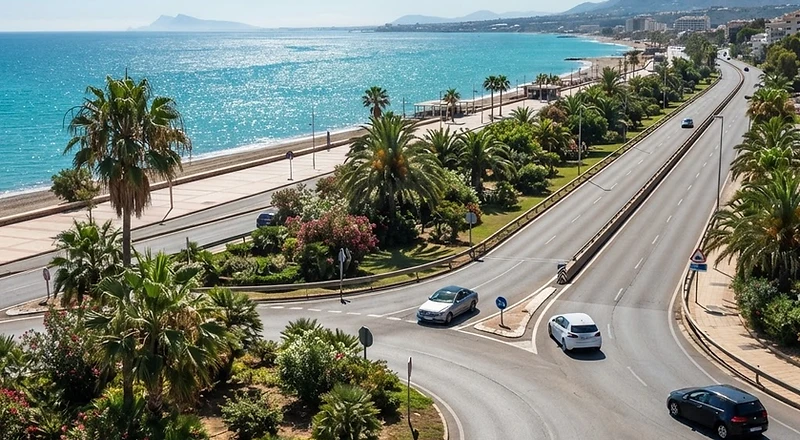
Infrastructure Delays Prompt New Málaga Transport Upgrades
Gridlock on coastal corridors prompts municipal authorities and regional planners to accelerate infrastructure and junction upgrades.
Bottlenecks Along the Coastal Spine
Drivers heading along the A-7 between Malaga Airport and Fuengirola know the drill by now: a steady crawl that starts around 8am and doesn't really let up until mid-morning, then returns with a vengeance from 5pm onwards. The un-tolled sections of this coastal artery, which carries traffic through some of the most densely populated stretches of the Costa del Sol, are operating at close to full capacity on a daily basis. That's not a seasonal quirk any more — it's become the baseline.
Part of the problem is straightforward arithmetic. The province's resident population has grown steadily over the past decade, and the summer tourism season now stretches well beyond the traditional July-August peak, with shoulder months in spring and autumn adding extra vehicles to a road network that was never designed for this volume. Commuters travelling from inland municipalities towards the coast, combined with holidaymakers navigating unfamiliar junctions, create a mix that slows everything down and makes journey times genuinely hard to predict.
Town halls along the coast have started responding with targeted, local fixes rather than waiting for a single grand solution. Engineering works are now scheduled across several municipalities, with a focus on the worst pinch points at highway junctions. New roundabouts, underpasses and pedestrian footbridges are being planned specifically to pull local traffic — school runs, shopping trips, short hops between neighbourhoods — away from the high-speed intercity flow on the A-7 itself. The logic is simple: separate the two types of journey, and the whole system moves more freely.
Impact on Neighbourhood Property Value
For international buyers weighing up a purchase on the Costa del Sol, infrastructure has quietly become one of the more decisive factors in the decision-making process. Estate agents tracking sales data report that properties within roughly a kilometre of newly finished transport links, expanded hospital facilities, or step-free coastal boardwalks tend to attract stronger interest and sell noticeably faster than comparable homes further from these amenities.
That pattern is visible in areas such as San Pedro Alcántara, Mijas Costa and Estepona, where completed infrastructure work has already changed daily life for residents in practical terms. A new underpass or footbridge might sound like a modest addition on paper, but for a family doing the school run twice a day, or a retiree trying to reach the seafront without crossing four lanes of traffic, it's the difference between a five-minute walk and a stressful detour. Developers marketing new builds in these zones are increasingly leading with connectivity in their sales pitches, well aware that buyers are asking pointed questions about access roads and commute times before they ask about pool sizes or sea views.
This shift in buyer priorities has knock-on effects for how developments are planned. Projects with direct, well-engineered access to the A-7 or to public transport nodes are being positioned — and priced — differently from those reliant on older, congested feeder roads. Anyone researching the market through outlets such as Marbella New Homes will find that proximity to upgraded infrastructure now features prominently in property descriptions, reflecting exactly what buyers are asking for.
Demands for Long-term Mobility
Local fixes only go so far, and coastal leaders are the first to admit it. Roundabout adjustments and slip-road widening ease pressure at specific points, but they don't address the underlying structural problem: a coastal road network still leaning heavily on a single congested artery. Municipal authorities are continuing to lobby regional and central government for two things in particular — concrete progress on mass-transit feasibility studies that could eventually take private cars off the road altogether, and toll exemptions on the AP-7 that would encourage more drivers to use the quieter, currently under-utilised alternative route.
Autumn typically brings a round of infrastructure reviews, and this year is no exception. Councils, business associations and residents' groups are watching closely to see which of these proposed works actually reach the tender stage before the year is out, since a headline announcement is one thing and a signed contract is quite another. For now, the message from the coast is consistent: incremental improvements are welcome, but nobody is under any illusion that a few new roundabouts will solve a problem this size on their own.
Related news


Álora Celebrates Historic Culinary Legacy with Annual Perotas Soup Festivities
Álora marks the historic tradition of its agricultural harvest dish as culinary lovers gather in the Guadalhorce Valley for the iconic Perotas Soup Day.


Yunquera Fair Launches Autumn Festivities with Deep Mountain Cultural Traditions
Yunquera enters its autumn celebrations this week, drawing visitors into the dramatic Sierra de las Nieves with folk music, religious processions and mountain hospitality.


Costa del Sol Hospitality Leaders Contest Rigid Coastal Environmental Rules
Beach restaurant operators and chiringuito federations across the coast launch talks with authorities to modernise restrictive coastal concession regulations.