Malaga Airport Guide: Terminals, Transfers and Parking Tips
Malaga Airport guide: how terminals T2 and T3 work, the C-1 train to the city centre, bus, taxi and parking options, lounge access, and the 100 ml liquid rule that still applies in 2026.
Malaga Costa del Sol Airport, known by its code AGP, is the busiest airport in Andalusia and one of the four busiest in Spain. Around sixty airlines operate from it, with direct connections to 89 destinations, and September 2026 alone brought 2.8 million passengers through its doors. For most visitors it is the first and the last impression of the coast, and it is a well-organised one, provided you know your way around. This guide covers the practical side: terminals, security, the train, taxis, buses, parking and lounges.
One airport, two working terminals
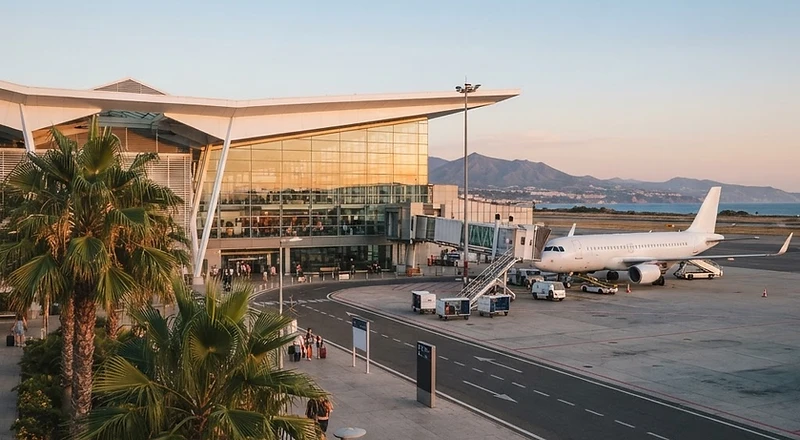
Malaga operates from two passenger terminals, T2 and T3, joined into one continuous building that you can walk end to end in about ten minutes. The older T1 no longer handles regular flights, so if your boarding pass says T2 or T3 you are already in the right half of the building. Terminal T3 handles most international traffic, while low-cost departures are spread across both. The rule is simple: trust the terminal printed on your booking confirmation, and confirm it on the flight information screens when you arrive, because terminals can change at short notice. Ryanair, Vueling, easyJet, Norwegian and Iberia are the largest carriers by number of departures.
Arrivals come out on the ground level. Baggage reclaim halls sit directly below the departures floor, and the moment you step outside you are facing the transport hub of the entire airport: commuter rail below ground, bus stops and taxi ranks at the kerb, and the city barely fifteen minutes away.
Getting through security without surprises
The rule that still catches people in 2026 is the liquid limit. Despite scanner upgrades in some British and Swiss airports, the European Union rule remains in force at Spanish airports: liquids, gels, pastes and aerosols in hand luggage must be in containers of no more than 100 millilitres, all fitting into one transparent one-litre bag, one bag per passenger. Do not assume the relaxed rules you read about for London apply at Malaga; security staff at AGP enforce the 100 ml limit as standard. Laptops and large electronics leave the bag, belts and jackets come off, and if you are travelling with a power bank it must ride in the cabin, never in checked luggage.
Timing is the other half of the puzzle. For short-haul flights two hours before departure is enough most of the year. Add an hour on summer Saturdays and Sunday evenings, when the departure hall fills with package-tour waves. Long-haul and early-morning departures deserve three hours.
The train to the city, and down the coast
The cheapest and often the fastest link to the centre is the C-1 commuter line, whose station sits directly below Terminal T3, an easy walk from baggage reclaim. Centro Alameda, on the western edge of the old town, is about twelve minutes away. A single starts at 1.80 euros, rising to about 2.30 euros depending on zones. Trains run roughly every twenty minutes from early morning until around one in the morning, and the same line continues west: Torremolinos in under ten minutes, Benalmadena-Arroyo de la Miel a little further, and Fuengirola at the end of the line in under forty. If your hotel or apartment is anywhere on that corridor, the train beats a taxi in every month of the year.
Bus, taxi and private transfers
The EMT express bus line A runs from the terminal forecourt to the city centre along the Alameda, with departures every twenty to thirty minutes through the day and a journey time of about twenty minutes. Fares have been updated in recent years, so expect to pay a few euros per person and check the current price before you board.
Taxis wait at the rank outside arrivals. A run to the centre typically costs between 17 and 25 euros depending on traffic, the hour and the number of suitcases. The queue moves quickly even at peak times, and drivers are used to addresses given in a mix of English and poor Spanish. Private transfer drivers, including the shuttle desks in arrivals, are the alternative for the western coast: Marbella is about forty minutes by car and Estepona closer to an hour, which is why many coastal visitors book a transfer in advance rather than queue for a metered taxi.
Parking at Malaga airport
The airport offers covered general parking directly opposite the terminal and cheaper long-stay options a short shuttle ride away. The gap between turning up at the gate and booking the same space online in advance is significant, often half the price or better in high season, so pre-booking is the single most useful thing a departing driver can do. The drop-off zone at the kerb is charged by the minute, so if you are seeing someone off without parking, use it quickly. For arrivals pickups, the short-stay car park gives a grace window measured in minutes, which is usually enough to meet a flight that has already landed.
Lounges and the airside experience
Aena-run lounges serve both passenger areas, and you do not need a business-class ticket to use them. Access comes through membership programmes such as Priority Pass, through some premium credit cards, or by paying at the door, with prices varying by season and crowd. Inside you get a quiet seat, drinks, snacks, showers in some locations and wifi that is less saturated than the terminal network. Beyond the lounges, both airside areas carry the usual Spanish chain of duty-free shopping, tapas bars and coffee counters, plus drinking water fountains near the restrooms, worth remembering when a 0.5 litre bottle costs airport prices.
What is changing at the airport
Malaga airport is in the middle of the largest rebuild in its history. A second runway is close to completion, and the published plans point to capacity rising towards 72 movements per hour, up from about half that today, alongside a wider expansion plan reported at around 1.5 billion euros intended to double terminal capacity. Terminal infrastructure works are already under way, mostly at the edges of the site, so expect fencing and crane silhouettes but no detours on foot yet. The detail of the expansion schedule is still being finalised, so treat any completion date you read, including here, as provisional.
The final word
A busy international airport fifteen minutes by train from a historic city centre, and forty minutes by car from Marbella, is a large part of why the Costa del Sol works as a place to live and not only to visit. The airport is compact, honest about its queues and improving quickly. Arrive with the liquid rules respected, the terminal checked and the train ticket understood, and Malaga airport becomes one of the least stressful big airports in southern Europe.
Related news


Golden Visa Spain 2026: Status and the Alternatives Now
Golden Visa Spain closed on 3 April 2025. What existing holders keep, and the 2026 alternatives: the non-lucrative visa at 28,800 euros a year and the digital nomad visa.


Empadronamiento Spain: How to Register on the Costa del Sol
Empadronamiento on the Costa del Sol: the documents you need, how to book appointments in Marbella, Fuengirola, Mijas and Estepona, and the two-year renewal rule.


Non-Resident Tax Spain: Modelo 210 Deadlines for 2027
Non-resident tax in Spain explained: how Modelo 210 works for Costa del Sol property owners, who pays 19 or 24 percent, and what Orden HAC/623/2026 changed about the deadlines for 2026 and 2027.
Free Guide: Buying Property in Spain 2026
A step-by-step guide for international buyers — from NIE to the notary.
We'll send you the guide link by email too. No spam — your details stay with Marbella New Homes.