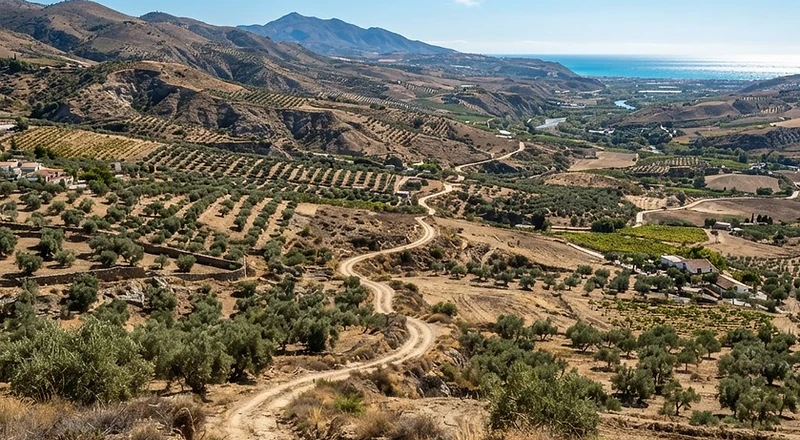
Malaga Mobile Home Crackdown: Inland Town Halls Enforce Strict Planning Laws
Provincial authorities and town councils across Malaga are escalating enforcement measures against unauthorised mobile homes and prefabricated chalets on rustic land.
Inland Councils Turn Up the Pressure on Illegal Rural Homes
Inspectors have begun working through rural plots across Malaga Province, checking agricultural land for prefabricated homes, container conversions and static caravans that were never meant to become permanent residences. The checks are not isolated incidents. Town halls in the Guadalhorce Valley and the Axarquía, along with several other inland municipalities, are coordinating with regional environmental prosecutors to identify structures built without planning permission on land classified as non-urbanisable.
For years, small rural parcels planted with olive or almond trees have offered an affordable route onto the property ladder for foreign buyers and domestic retirees priced out of the coast. A modest plot inland can cost a fraction of a comparable coastal property, and the appeal of open countryside, lower noise levels and a slower pace of life has drawn steady interest from British, Dutch, German and Scandinavian buyers in particular. That affordability, however, has often come with a legal catch that many purchasers only discover after the fact.
Why "Mobile" Doesn't Mean Exempt
Much of the confusion stems from how these properties are sold. Buyers are frequently told that because a structure sits on wheels, stilts or loose concrete blocks, it counts as a movable possession rather than a building, and therefore escapes the permitting rules that apply to conventional construction. Planning departments across Andalusia reject that argument outright.
Under regional zoning law, any unit used for permanent or semi-permanent residential accommodation falls within the scope of urban planning codes, regardless of whether it could theoretically be hitched to a vehicle and towed away. Connecting a unit to a private borehole, a septic tank, a cesspool or a solar installation strengthens the case that it functions as a home rather than a temporary shelter, and councils treat that evidence accordingly. Without a specific municipal licence for residential use, placing such a dwelling on rustic land remains prohibited, however the structure is marketed.
How the Crackdown Is Being Carried Out
Enforcement has sharpened noticeably in recent weeks. Councils are using aerial drone surveys alongside updated cadastral satellite mapping to cross-reference what's actually on a plot against what planning records allow. Discrepancies, a new structure, an unregistered pool, a fenced-off encampment, are flagged for follow-up visits by municipal and regional environmental agents.
Owners who receive a formal notice face administrative fines that can run into tens of thousands of euros. Where a property sits within a protected ecological corridor or affects a watercourse, councils are going further, asking the courts to order full demolition and restoration of the land at the owner's cost. These are not symbolic gestures. Once a judicial demolition order is issued, local authorities have the legal basis to enforce it, and the financial burden falls squarely on the registered owner.
Advisers working with the expatriate community are urging anyone weighing up an off-grid or prefabricated purchase to take independent urban-planning legal advice before signing anything, ideally before even putting down a deposit. For those wanting a legitimate, compliant route into the property market, consulting an established local agency such as Marbella New Homes offers a more secure alternative to unverified rustic-land schemes that circulate informally among buyers.
What Happens Next for Rural Residents
Local mayors frame the clampdown as a matter of protecting both landscape and water supply. Inland Andalusia depends heavily on underground aquifers, and unregulated development, particularly homes relying on private boreholes and unlicensed waste disposal, adds pressure to a resource already stretched by prolonged dry spells. Councils argue that without enforcement, scattered unauthorised housing could spread unchecked across agricultural zones never designed to support it.
For residents currently facing proceedings, the advice from town halls is consistent: engage directly with the local urbanismo department rather than waiting for the process to escalate. Some properties may qualify for limited legal protection under existing regional provisions known as asimilado a fuera de ordenación, a status that doesn't legalise a building outright but can, in certain circumstances, shield it from immediate demolition while regularisation is explored. Whether that route is available depends heavily on the specific plot, its classification and its environmental sensitivity, which is why early contact with planning officials, rather than silence, is being presented as the safest option for anyone caught up in the sweep.
Related news


Malaga industrial estates: businesses demand road upgrades
Malaga industrial estates call on local authorities for urgent road infrastructure upgrades and firm timetables as Costco opening threatens gridlock.


Malaga housing deficit: Savills warns 30,000 homes short
Malaga housing deficit worsens as Savills report warns 30,000 planned homes fall short of demand, with only 3,000 units expected within five years.


Málaga public transport hits 50 million rides in 2026
Málaga public transport recorded nearly 50 million journeys across city buses and the metro during the first eight months of 2026, leading Spanish transit growth.
Free Guide: Buying Property in Spain 2026
A step-by-step guide for international buyers — from NIE to the notary.
We'll send you the guide link by email too. No spam — your details stay with Marbella New Homes.