
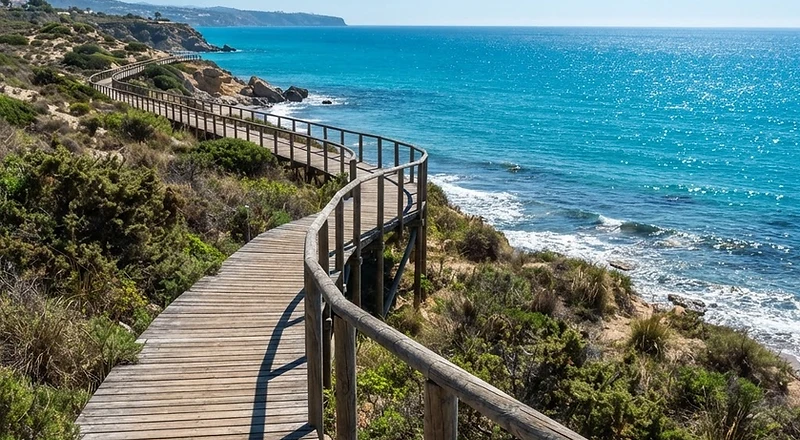
Málaga Province Expands Senda Litoral Coastal Boardwalk
Málaga Province connects Mijas and Estepona via the new Senda Litoral boardwalk. See how this coastal project boosts property values and local tourism.
Work crews are set to break ground within weeks on some of the last unpaved gaps in the Senda Litoral, the coastal footpath that has slowly stitched together beaches, cliffs and residential stretches across Málaga province over the past two decades. Regional public works officials this week signed off on technical tenders covering three difficult shoreline sections, moving the long-running project a step closer to a continuous, traffic-free walking corridor along much of the Costa del Sol.
The sections earmarked for work sit on rugged beachfront easements between western Mijas Costa and eastern Estepona — precisely the kind of terrain that has defeated previous phases of the scheme. Steep cliffs, protected dune systems and, in places, private estates abutting the shoreline have historically pushed walkers and cyclists inland onto service lanes running alongside the N-340, a road never designed with pedestrians in mind. Closing these gaps has been a recurring ambition of provincial planners for years, and this latest tender represents one of the more technically demanding stretches still outstanding.
Practical Upgrades for Daily Walkers
Rather than pouring concrete over sensitive dune habitat, engineers have opted for modular eco-timber decking raised on helical steel footings. The design lets sand drift and rainwater run beneath the structure rather than pooling against it, reducing the erosion problems that have plagued cruder path solutions elsewhere on the coast. Each completed segment will include wheelchair-accessible ramps, low-intensity lighting calibrated to meet coastal conservation rules that protect nesting wildlife, and clearly marked cycle lanes separate from the pedestrian route.
For residents who currently have no choice but to cross slip roads or scramble over rocks to keep walking along the shore, the upgrades matter well beyond aesthetics. A continuous, level path changes how people actually move around these urbanisations — dog walkers, parents with buggies, older residents who might otherwise avoid uneven ground, and commuters cycling between coastal towns all stand to benefit once the gaps close.
Timeline and Construction Logistics
Civil engineers plan to begin staging heavy equipment at designated access points by early November, timed deliberately to avoid the peak summer season when beachfront restaurants and sunbathers crowd these same stretches. Contractors have indicated the goal is to keep disruption to a minimum for businesses that depend on beach footfall even in the shoulder months.
Project managers are targeting completion in time for the newly built sections to open ahead of next spring's holiday season — a realistic window if the current tender timetable holds, though anyone who has followed the Senda Litoral's construction history over the years knows that coastal engineering projects of this kind can run into delays tied to weather, permitting or unexpected ground conditions.
Measurable Gains for Shoreline Neighbourhoods
The economic case for finishing these gaps is not theoretical. Where boardwalk sections have already opened elsewhere along the coast, frontline properties with direct pedestrian access to the beach have tended to see firmer resale values and stronger short-term rental occupancy than comparable homes reliant on car access or a walk along the N-340. For agents and buyers weighing up coastal apartments between Mijas and Estepona, proximity to a finished stretch of the Senda Litoral has become a genuine selling point rather than a minor footnote.
Hospitality operators along the affected stretches have likewise welcomed the tendering timeline. Bars, chiringuitos and small hotels that depend on steady footfall from resident walkers, runners and cycling commuters — not just holidaymakers — see the path as something closer to infrastructure than amenity, since it underpins daily traffic between coastal urbanisations year-round.
What Comes Next
Attention now turns to whether contractors keep to the November start date and the promised spring opening. For homeowners and prospective buyers along this stretch of coast, the completion of these remaining gaps will mark one of the more tangible improvements to daily life in years — turning a patchwork of beach access points into something closer to a single, walkable coastline from Mijas to Estepona. Those following the property market in these towns, including through resources such as Marbella New Homes, will be watching closely to see whether the improved connectivity feeds through into fresh interest in frontline developments once the boardwalks are finished.
Related news


Álora Celebrates Historic Culinary Legacy with Annual Perotas Soup Festivities
Álora marks the historic tradition of its agricultural harvest dish as culinary lovers gather in the Guadalhorce Valley for the iconic Perotas Soup Day.

Yunquera Fair Launches Autumn Festivities with Deep Mountain Cultural Traditions
Yunquera enters its autumn celebrations this week, drawing visitors into the dramatic Sierra de las Nieves with folk music, religious processions and mountain hospitality.

Costa del Sol Hospitality Leaders Contest Rigid Coastal Environmental Rules
Beach restaurant operators and chiringuito federations across the coast launch talks with authorities to modernise restrictive coastal concession regulations.