Málaga Table Olive Harvest: 63,000 Tonnes (3rd in Andalusia)
Málaga is confirmed as Andalusia's third-largest table olive producer with a forecast 63,373-tonne harvest for 2026/27, closing in on Córdoba as the region projects 466,037 tonnes, 9% up on last year.
Málaga's quiet success story, away from the coast
While cranes continue to rise along the beachfront and estate agents chase another record year for property sales, a very different sector of the Málaga economy has just posted its own set of impressive numbers. According to the latest olive production forecast — the aforo — published by the regional agriculture department, the province is on course to harvest an estimated 63,373 tonnes of table olives in the 2026/27 campaign, cementing its status as Andalusia's third-largest producer behind Córdoba and Sevilla.
It is a figure that rarely makes headlines on the coast, where conversations tend to revolve around hotel occupancy rates and new-build developments. Yet it matters to the province's wider economy, and to the thousands of families in Málaga's interior for whom the olive harvest remains an annual fixture of working life, much as the tourist season is for those closer to the shoreline.
Closing the gap on Córdoba
The numbers put Málaga within striking distance of second-placed Córdoba, whose forecast stands at 70,066 tonnes — a difference of fewer than 7,000 tonnes. Sevilla remains comfortably out in front, with an estimated 320,000 tonnes, roughly five times Málaga's projected output. Between them, the three provinces account for more than 97% of all table olive production across Andalusia, leaving little room for the remaining five provinces to make a meaningful dent in the regional total.
The forecast was presented by regional agriculture minister Ramón Fernández-Pacheco in Mengíbar, in neighbouring Jaén province, as part of a wider regional report. That report estimates total Andalusian table olive production at 466,037 tonnes for the coming campaign, a rise of 9% on the previous year and 7.2% above the average of recent campaigns. Málaga's contribution works out at around 13.6% of that regional total, meaning roughly one in every seven table olives picked across Andalusia this season will have been grown in the province.
Where the olives come from
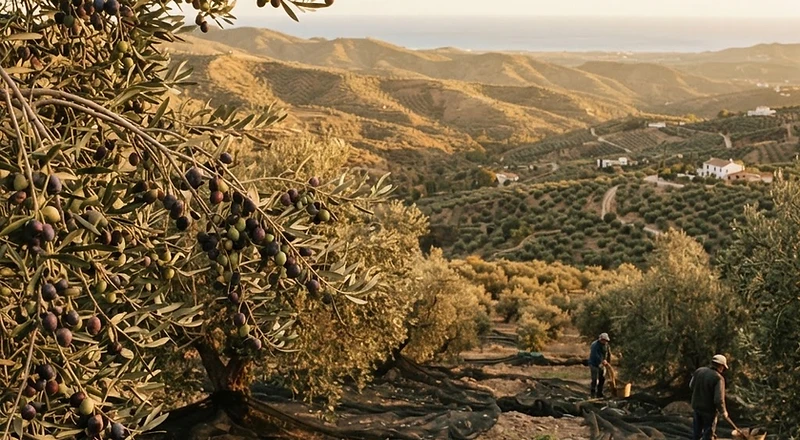
The harvest is not spread evenly across Málaga. The groves that matter most sit inland, away from the resorts and golf courses, concentrated around Antequera and the Guadalhorce valley, where the terrain and climate have long suited olive cultivation. These districts, often overlooked by visitors heading straight for the beaches, form the backbone of the province's agricultural economy and employ seasonal workers during the autumn and winter picking months.
By variety, Hojiblanca dominates regional production with 60% of the total, followed by manzanilla at 31% and gordal at 5%. All three varieties are well represented in Málaga's growing areas, and it is this mix — rather than a single dominant crop — that has allowed the province to build a consistent table olive industry over recent decades.
The picture for olive oil, a related but separate product, is equally strong this year. The regional forecast puts Andalusian olive oil production at 1,261,200 tonnes, an increase of 23.9% on the previous campaign and 44% above the five-year average — numbers that point to a genuinely strong season for the sector as a whole, even if table olives and oil-pressing olives are counted and marketed differently.
A wet winter, then a hot summer
Officials at the regional agriculture department describe the 2026/27 campaign as one of "medium-high" production rather than an outright record. A notably wet winter gave the crop a strong start, helping trees develop fruit in good condition across the growing regions. But unusually high temperatures later in the season limited how far that early promise translated into final yield, tempering what might otherwise have been an exceptional harvest.
For growers in Málaga's interior, that combination of factors is a familiar one: weather conditions early in the agricultural year can set the tone for months, but a hot, dry summer can just as easily cap potential before the olives are ready for picking. The result this year is a solid, above-average campaign rather than a historic one — enough to consolidate Málaga's position in third place nationally within Andalusia, without threatening Córdoba's hold on second.
It serves as a useful reminder, too, that Málaga's economy extends well beyond the coastal strip most visitors and new residents come to know. Behind the beaches, the marinas and the steady flow of property transactions, the hills above the Costa del Sol are still doing what they have done for generations: producing one of the region's most enduring agricultural exports.
Related news


Golden Visa Spain 2026: Status and the Alternatives Now
Golden Visa Spain closed on 3 April 2025. What existing holders keep, and the 2026 alternatives: the non-lucrative visa at 28,800 euros a year and the digital nomad visa.


Empadronamiento Spain: How to Register on the Costa del Sol
Empadronamiento on the Costa del Sol: the documents you need, how to book appointments in Marbella, Fuengirola, Mijas and Estepona, and the two-year renewal rule.


Non-Resident Tax Spain: Modelo 210 Deadlines for 2027
Non-resident tax in Spain explained: how Modelo 210 works for Costa del Sol property owners, who pays 19 or 24 percent, and what Orden HAC/623/2026 changed about the deadlines for 2026 and 2027.
Free Guide: Buying Property in Spain 2026
A step-by-step guide for international buyers — from NIE to the notary.
We'll send you the guide link by email too. No spam — your details stay with Marbella New Homes.