Spain Residency Guide: Types, Renewal Rules and Deadlines
Spain residency in 2026: NIE vs residencia, the EU green certificate, the TIE card, non-lucrative and digital nomad income thresholds, and the 60-day renewal window under Royal Decree 1155/2024.
Residency in Spain is not one document but a family of them, and using the wrong word at the wrong counter can cost you weeks. This guide breaks down what "residencia" actually means in 2026, which card or certificate applies to you, what the renewal rules are under the immigration regulation that took effect in May 2025, and which numbers you have to meet.
NIE is not residency
Start with the confusion that traps most newcomers. The NIE, the numero de identidad de extranjero, is only a tax and identification number. You can hold an NIE, buy a property, open a bank account and pay Spanish taxes, and still be a non-resident. Residency is a separate legal status, declared either at the town hall padron office or through an immigration file. If you spend more than 183 days in Spain per year, the tax office will typically treat you as tax resident whether you registered or not, so the two decisions should be made together.
EU citizens: the green certificate
If you are a citizen of an EU country, Switzerland, Norway, Iceland or Liechtenstein, you do not get a TIE. After three months of living in Spain you register at the Oficina de Extranjeria and receive the green A4 certificate, the certificado de registro, with your NIE printed on it. The certificate itself does not carry an expiry in the way a card does; you only need a new one when your personal data changes, and issuing it costs a small fee on the corresponding 790 form, currently under ten euros. The real obligations for EU citizens sit elsewhere: the empadronamiento at your local town hall and, after five years of continuous residence, the permanent residence certificate.
Non-EU citizens: the TIE card
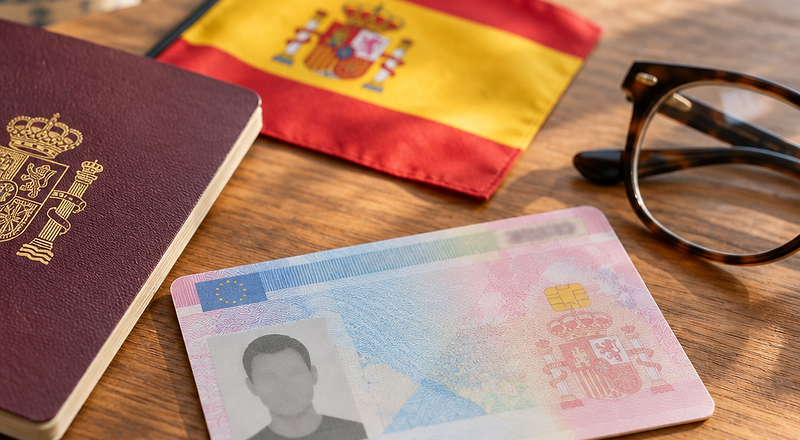
Third-country nationals live in a card system. The tarjeta de identidad de extranjero, the TIE, is the physical card that documents your residence authorisation. It shows your photo, your NIE, your nationality, your permit type and its expiry date. Every change of status, every renewal, every first arrival ends with an appointment at a police station for fingerprints and, a few weeks later, the card itself. The issuance fee is 12 euros, paid on the 790-012 form.
The main permit types in 2026
The non-lucrative visa remains the classic route for people with passive income: pensions, rents, dividends, savings. The first authorisation runs one year, and the financial bar is set from the IPREM, Spain's public income benchmark, which has been frozen at 600 euros per month, 7,200 euros per year, since 2023. You need 400 percent of it, so 28,800 euros per year, roughly 2,400 euros per month, plus an extra 100 percent, 7,200 euros per year, for each family member included in the file.
The digital nomad track covers employees and freelancers working remotely for companies or clients outside Spain. The visa itself is typically granted for up to one year, while the residence authorisation behind it runs up to three years and renews in two-year steps. The income floor is calculated from the Spanish minimum wage, which was set at 1,221 euros per month for 2026. The rule asks for roughly 200 percent of it for the main applicant, which works out at somewhere between about 2,442 and 2,849 euros per month depending on whether the calculation uses the twelve-month or the fourteen-payment proration, and published sources differ on the exact figure, so treat it as a range and check the current instruction before filing. A partner adds roughly 75 percent and each child 25 percent to the threshold.
Work permits are tied to the employer for the first cycle and open up after renewal, student permits now allow up to 30 hours of paid work per week under the regulation in force since 20 May 2025, and family reunification permits follow the status of the person already resident.
After five years of continuous legal residence, non-EU residents can apply for long-term residence. The long-term card still carries an expiry date and has to be replaced like any card, but the status behind it no longer depends on annual renewals, which converts the whole cycle into a much lighter routine.
The renewal rules that changed in 2025
The new immigration regulation, Royal Decree 1155/2024, has applied since 20 May 2025, and it rewired the renewal calendar. The core rule every resident should memorise: you may file the renewal from 60 days before your card expires, and you keep the right to file up to 90 days after expiry. Filing inside that 90-day window after the card has already expired does not kill the application; the renewal is granted with retroactive effect so the residence is treated as continuous.
That said, the safe play is always the early one. Book the cita previa as soon as the window opens, because in the offices of Malaga, Fuengirola, Marbella and Estepona free appointments are claimed fast, and a delayed appointment after expiry leaves you presenting an expired card while the file is processed.
What a renewal actually requires
A standard renewal file, whatever the permit type, is built from four things. First, the application form, the EX model that matches your track, submitted through the electronic registry, by appointment, or by registered mail. Second, your passport, valid for the duration you are asking for, plus a copy. Third, proof that you still meet the conditions of your track: for the non-lucrative route that is renewed income proof at the same 400 percent threshold, for the digital nomad track the employment contract, the invoices or the client letters, for work permits the job contract. Fourth, a recent criminal record certificate, which more tracks now ask for since the regulation changed.
For most renewals of the residence authorisation itself there is no processing fee; the 12 euros falls due when the new card is issued. Some procedures carry a fee on the 790-052 form, so confirm the current fee schedule for your specific track when you download the form.
The fingerprints and the card
Once the renewal is approved, you receive the resolution letter and book the police appointment for the huella, the fingerprints. Bring the letter, your passport, the current card if you still hold it, the 790-012 payment and a passport photo. The card is then printed and collected in person at the same station, usually within a few weeks of the appointment. In Malaga province the collection turnaround is typically the fastest part of the whole cycle.
What trips people up on the Costa del Sol
Three patterns repeat every season. Residents who travel for months and return to find the card expired past the 90-day window, where the only route is a fresh application from scratch. Renewals filed on the strength of a bank balance that no longer meets the 400 percent threshold, which is the single most common refusal ground for non-lucrative renewals. And the assumption that residency is the same thing as tax residency, which it is not, and which matters because the tax office makes its own 183-day judgement regardless of what your card says.
The practical sequence: diary your expiry date, open the file at day minus 60, keep the income proof at or above your original threshold, and treat the cita previa as the scarce resource it is. Residency in Spain rewards the early, not the fast.
Related news


Golden Visa Spain 2026: Status and the Alternatives Now
Golden Visa Spain closed on 3 April 2025. What existing holders keep, and the 2026 alternatives: the non-lucrative visa at 28,800 euros a year and the digital nomad visa.


Empadronamiento Spain: How to Register on the Costa del Sol
Empadronamiento on the Costa del Sol: the documents you need, how to book appointments in Marbella, Fuengirola, Mijas and Estepona, and the two-year renewal rule.


Non-Resident Tax Spain: Modelo 210 Deadlines for 2027
Non-resident tax in Spain explained: how Modelo 210 works for Costa del Sol property owners, who pays 19 or 24 percent, and what Orden HAC/623/2026 changed about the deadlines for 2026 and 2027.
Free Guide: Buying Property in Spain 2026
A step-by-step guide for international buyers — from NIE to the notary.
We'll send you the guide link by email too. No spam — your details stay with Marbella New Homes.