Axarquia Drug Boat Fuel Network Dismantled in Police Sting
National Police arrest eight people in a petaqueo operation across Malaga, Cadiz and Ceuta, cutting the petrol supply that kept drug launches running off the Axarquia coast.
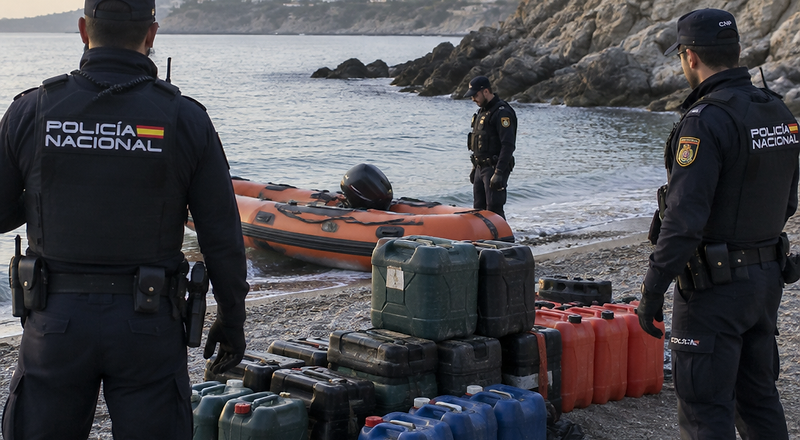
The National Police has dismantled a fuel network that kept drug launches moving off the Axarquia coast, arresting eight people in a coordinated operation that reached from Malaga province down to Cadiz and across to Ceuta. The roundup, confirmed on 13 November by several national newspapers citing the force, targeted what investigators in Spain call petaqueo: the clandestine supply of petrol to the crews of the semi-rigid boats used to move hashish from North Africa to the beaches and coves of the eastern Costa del Sol.
Four of the arrests took place in the province of Malaga, three in Cadiz and one in Ceuta. Among those detained, according to the reports, are the suspected authors of a shootout against officers of the National Police's organised crime unit, UDYCO. The suspects face allegations covering attempted homicide, assault on law enforcement officers, drug offences, road safety offences and the illegal possession of weapons.
Petaqueo has become a fixture of the coastal drug economy. The launches that carry bales of hashish across the Strait of Gibraltar burn enormous amounts of fuel on every run, but their crews cannot simply fill up at a marina without attracting attention. Middlemen buy petrol at ordinary filling stations, store it in canisters and resell it to the boat operators at a heavy markup, quietly turning everyday forecourts into links in the trafficking chain. Investigators treat these suppliers not as marginal figures but as the logistics that decide whether a launch puts to sea at all, which is why the operation was presented as a blow against drug trafficking on the Costa del Sol rather than a routine swoop.
The Axarquia's coastline explains why the comarca keeps appearing in these stories. Fishing harbours, isolated coves and long, dark stretches of beach between Velez-Malaga and Nerja have made the area a recurring entry point for drug launches, and press reports of night-time landings or bales washing ashore are, for local residents, an old and unwelcome tradition. Villages such as Torrox, Algarrobo and Sayalonga sit in the hills above some of the most quoted stretches of water in Spain's hashish route, and the police response has grown with the traffic: more coastal patrols, more surveillance from the air and, as this operation shows, a focus on cutting the supply chain rather than waiting for boats to arrive.
For foreign residents and the growing number of international buyers drawn to the Axarquia's white villages and lower prices, the practical impact of such operations is usually indirect. Thefts and violent score-settling in this trade are overwhelmingly disputes between trafficking groups, not acts aimed at residents or visitors, and daily life in towns like Nerja, Frigiliana and Competa continues largely untouched. What locals do notice is the occasional closed beach while a package is recovered, a heavier police presence at dawn on coastal roads, and the headlines themselves, which do the region's reputation no favours even when the news is good.
The investigation remains open under court supervision, as is customary in Spain, and further arrests have not been ruled out. What the operation signals is a change of method along this coast: instead of measuring success only by kilos seized, the police are dismantling the quiet services, fuel, transport, lookouts, that make the traffic possible. For the Axarquia, a district whose economy depends on tourism, expatriate settlement and the slow growth of the property market, fewer launches at sea eventually means calmer headlines, safer beaches and one less caveat in the conversations that buyers from northern Europe have about the region.
The next test will be whether the detentions hold up in court and whether the supply routes simply shift along the coast, as they have before. In the meantime the message from this operation is unambiguous: the fuel that moves the boats is now treated as seriously as the cargo they carry, and the network that sold it is short eight pairs of hands.
Related news

Axarquia Illegal Fishing Network Dismantled: 27 Investigated
Guardia Civil operation Modicum dismantles a network selling undersized and protected fish along the Axarquia coast, with 27 people under investigation.


Marbella Crime Wave: Vox Demands More Police After Stabbings
Several stabbings and a shooting in the El Ángel area have put Marbella's policing levels at the centre of a fierce political row, with Vox demanding more National Police.


Malaga Nightclub Shooting: Doorman Shot in Chest at Dawn
A 49-year-old doorman was shot in the chest at point-blank range outside a Cruz del Humilladero nightclub at around 7.30am on Sunday, and police are investigating.
Free Guide: Buying Property in Spain 2026
A step-by-step guide for international buyers — from NIE to the notary.
We'll send you the guide link by email too. No spam — your details stay with Marbella New Homes.