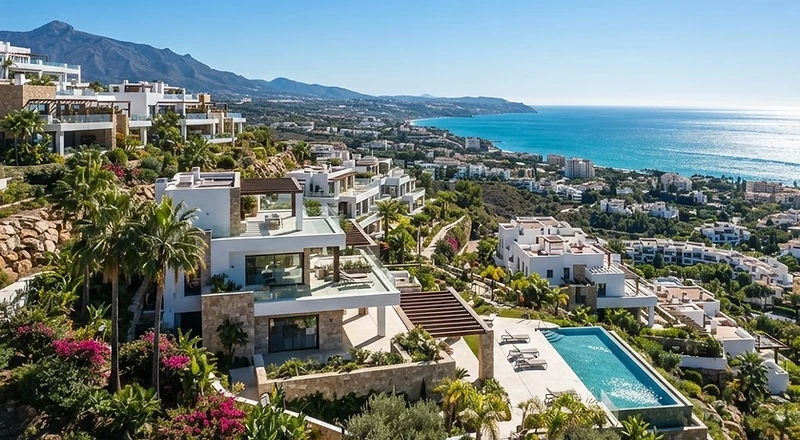
Marbella property expert Greg Adalbert analyzes the 2026
Marbella property expert Greg Adalbert analyzes the 2026 market trends. Explore current off-plan demand, European buyer shifts, and coastal development.
Every autumn the same question lands in estate agents' inboxes up and down the coast: is this the year the Marbella market finally cools? This week we put that question, and a good few others, to Greg Adalbert, who speaks for Marbella New Homes, one of the coast's busiest new-build agencies. We met in their office above Nueva Andalucía, with two tower cranes in view, which felt appropriate.
What follows is an edited version of a conversation about buyers, banks, off-plan risk and where — in his view — the smart money is looking in 2026.
The market did not slow down — it changed
Q: Everyone expected higher interest rates to take the heat out of the coast. That hasn't quite happened. Why not?
Because most of the people buying here are not borrowing, or not borrowing much. Our buyers from northern Europe — the Dutch, the Belgians, the Germans, and this year a noticeable wave of Poles — typically arrive with a sale behind them or with cash of their own. Mortgage rates matter enormously for a first-time buyer in Málaga city. They matter far less on a €900,000 villa in Benahavís. What the rate cycle changed was the mix of buyers, not the volume.
Q: Who is actually walking through the door this year?
Three groups, roughly. The classic retirement buyer is still with us, but is now a minority of our book. The fastest-growing group is the work-from-anywhere couple in their forties: one contract with a London or Amsterdam employer, one school-age child, and a hard requirement for fibre internet and an international school within twenty minutes. And the third group is the investor who watched rents in Marbella and Estepona climb for five straight years and decided the train had not left yet.
Off-plan is where the action is
Q: New-build keeps dominating the conversation. What are buyers getting that resale doesn't offer?
Certainty about costs, mostly. A new-build apartment comes with modern insulation, a communal pool that is not a €40,000 special levy waiting to happen, and energy bills a fraction of what a 1980s townhouse on the Golden Mile will cost you. Buyers have done that maths. Off-plan adds the payment structure — stage payments while the building rises, typically financed without interest — and the chance to choose the kitchen.
Q: And the risk? Buy from a drawing and you are trusting someone.
You are, and I say this to every client: trust the developer's track record, not the brochure. We only work with developers who have delivered before, and we tell buyers to go and stand in the last project the builder finished, not the showroom. The second rule is the bank guarantee: by law, stage payments on off-plan purchases in Spain must be insured. If the developer fails, your money comes back. A buyer who checks those two boxes is taking less risk than they think.
Q: Which areas are you telling people to watch?
If the budget reaches it, the stretch between Nueva Andalucía and the Golden Mile remains the most liquid market on the coast — the place where resale is fastest because demand never sleeps. Benahavís and the hills above it keep pulling buyers who want quiet within a fifteen-minute drive of the coast road. But the honest answer for value is Estepona: the town has spent a decade investing in its old centre and its promenade, prices still sit below Marbella's, and the infrastructure — the hospital, the schools, the road connections — has caught up with the demand. Beyond it, Manilva is the frontier, for now.
What could go wrong
Q: You sound relaxed. What keeps you up at night?
Supply, oddly enough. The problem is not too many cranes — it's too few of the right ones. Local plans limit where you can build, and what gets approved is mostly premium product, which slowly crowds out the nurse, the teacher, the young Spanish family. That has consequences ten years out, and town halls across the Costa del Sol know it. I also watch construction costs; they have cooled from their peak, but a second spike would push entry prices up faster than wages here can follow.
Q: And the buyers themselves — what do they get wrong?
They fall in love in July. The coast is a seductive place on a sunny afternoon and a demanding one in January, when the same apartment faces a full month of quiet streets. My honest advice: rent for a season first, and never skip the notary's small print. And use an independent lawyer. A good one is worth every euro.
The year ahead
Q: Finally — one prediction for 2026.
That the conversation moves from €2 million villas to the middle of the market, because that is where the tension now lives: the family who earns well, has €350,000 to €500,000, and wants a home on the coast. Whoever solves how to build well for that buyer in Marbella, Estepona or Mijas will own the next decade. The market has stopped being a curiosity for the wealthy and become a place where ordinary European lives get rearranged. That is the real story of 2026, and it is only just starting.
Marbella New Homes is the sponsor of Costa del Sol News. This interview was edited for length and clarity.
Related news

Marbella TodoDanza Festival Takes Over Historic Theatres and Plazas
Fourteen acclaimed dance troupes have arrived in Marbella as the 17th annual TodoDanza festival expands across city venues throughout October.


Carlos Alcaraz Chooses Puente Romano for Autumn Hard-Court Training
Four-time Grand Slam champion Carlos Alcaraz arrives in Marbella for a week of intensive court drills and fitness conditioning.


Inside Marbella's Branded Residences Boom: Armani, Fendi and D&G Redraw the Golden Mile
Armani, Fendi Casa, Dolce&Gabbana and Karl Lagerfeld are building within minutes of each other on the Golden Mile — inside the €4 billion branded residences boom reshaping Marbella.