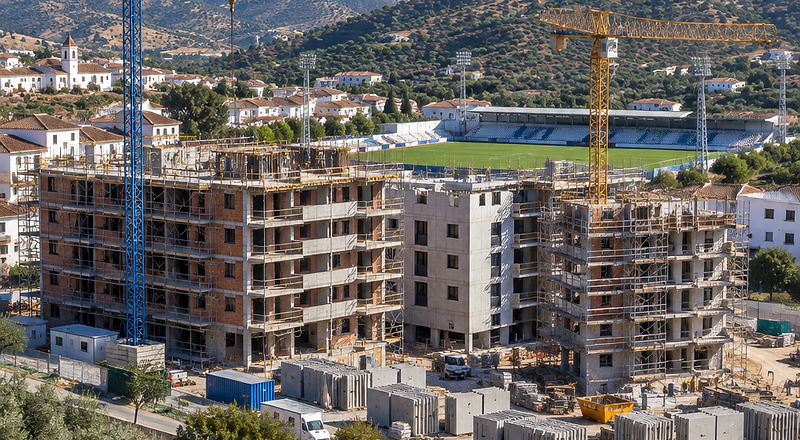
Vélez-Málaga Approves 96 Protected Homes Beside the Stadium
Vélez-Málaga's full council has given definitive approval to a scheme of 96 protected homes facing the Vivar Téllez stadium, around 20 per cent more units than first planned.
Vélez-Málaga has cleared the way for 96 protected homes on land facing the Vivar Téllez stadium, after the full council gave definitive approval to the detailed planning study for the plot.
The document approved at the plenary session raises the number of homes in the scheme by around 20 per cent against the figure originally envisaged. That is not a cosmetic change. It decides how much building can be fitted onto a plot wedged between an established residential neighbourhood and one of the town's best known sports venues, and it sets the tone for how the eastern side of the province grows over the next decade.
Protected housing in Spain, known as VPO, is sold or rented below market price under regional rules. Buyers have to fall under income limits, and the homes carry restrictions on resale for a set period so that the discount is not simply pocketed by the first owner. The mechanism is unglamorous and slow, but in a town where the gap between local wages and asking prices has widened sharply, those units are often the difference between a young family staying in Vélez-Málaga and moving inland or to the edge of Málaga city.
The Axarquía has become one of the more pressured corners of the province. Demand from the coast has pushed inland, remote work has pulled in buyers who would once have settled closer to the sea, and the rental stock has thinned out as owners moved towards short stays. Towns that spent years worrying about depopulation now worry about their children being priced out of the place they grew up in.
Definitive approval of the detailed study is a planning milestone, not a building permit. The promoter still has to produce an execution project, secure the building licence, arrange water, power and drainage connections, and settle the urbanisation works that come with a scheme of this size. On comparable developments in the province that sequence has taken anywhere between a year and three. No start date has been announced, and nobody involved has suggested otherwise in public.
The stadium setting cuts both ways. It gives the site a recognisable address and existing access roads, and it puts new residents within walking distance of the town centre rather than on a fresh fringe of sprawl. It also means match days, with the parking pressure and noise that come with them. Densities of this kind live or die on the details: whether the parking is underground or painted onto the surface, whether the access road is widened before the first family moves in, and whether the green space promised in the plan survives the value engineering that always arrives late in the process.
For the town hall the calculation is straightforward. Every protected unit approved now is a political answer to a housing debate that has become the loudest complaint in almost every Andalusian municipality. For the developer, the 20 per cent uplift is what makes a scheme on constrained urban land worth building at all.
What to watch next is the unit mix rather than the headline number. Ninety-six homes can mean a genuine neighbourhood or a dormitory, depending on how many two and three bedroom flats are included, whether any of the stock is for rent rather than sale, and how the price caps are set when the project is registered. Those details will not be settled at a plenary session, but in the paperwork that follows.
For residents, the practical takeaway is modest and clear. The plot opposite the stadium will be built on, the scheme will be bigger than first planned, and the first visible works are still some way off. Anyone hoping to apply for one of the homes should start reading the regional eligibility rules now, because waiting lists for protected housing in the province are measured in years rather than months.
Related news

Vélez-Málaga Mayor Resigns Over Rubbish Tax Revolt
Jesús Lupiáñez steps down as mayor of Vélez-Málaga with immediate effect amid protests over the new municipal rubbish tax, saying he cannot take more insults; the PP must now elect a successor at an extraordinary plenary.

Al-Assad Money Trail: 77 Million Euros and a Marbella Empire
A leak of Deutsche Bank documents shows 7,944 transactions worth 77.2 million euros linked to Rifaat al-Assad, the man who owned the Benabola complex in Puerto Banus and 3,300 hectares in Benahavis.

Casares Pueblo Mágico 2027: Property and Tourism Impact
Casares has been named a Pueblo Mágico de España for 2027, a national badge that puts its mountain village and its coastal strip in front of a new group of visitors and buyers.
Free Guide: Buying Property in Spain 2026
A step-by-step guide for international buyers — from NIE to the notary.
We'll send you the guide link by email too. No spam — your details stay with Marbella New Homes.