Costa del Sol Beaches Guide: The Best Sands Town by Town
Costa del Sol beaches guide: the best sand in every town from Nerja to Manilva, what the coloured flags mean, how water quality is checked and which beaches are accessible.
The Costa del Sol has 45 Blue Flag beaches this year, a count the province has now held for two seasons in a row, in a country that regularly leads the world in the award. That is the headline number, but it is almost useless for planning a beach day, because the flags are spread along some 160 kilometres of coastline and the sand, the waves and the crowds change completely from one town to the next.
So this guide does what the flag lists do not: town by town from east to west, the beach worth your towel in each one, plus the three questions everyone eventually asks, namely what the flags mean, how the water is checked, and which beaches you can use with limited mobility.
THE FLAGS, FIRST
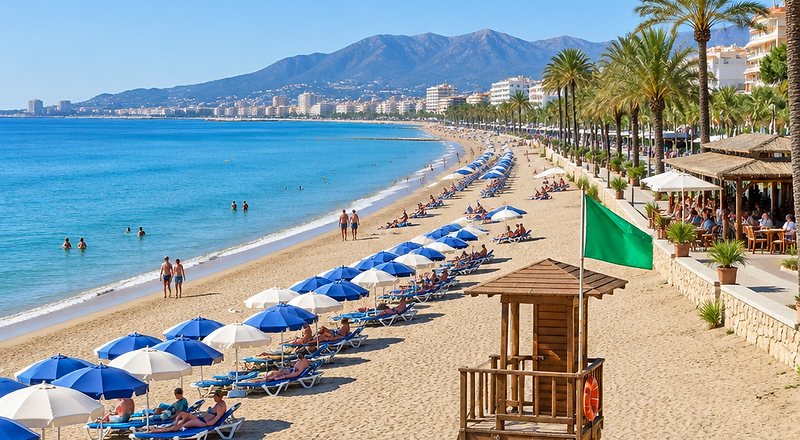
Every municipal beach in Spain flies a coloured flag from its lifeguard post in season. Green means swim freely. Yellow means you may bathe, but with caution: currents or waves are present, and inflatables and air mattresses are off limits, because an offshore wind will carry them out faster than anyone notices. Red means the beach is closed to swimming, and the ban is real: people drown every summer on Spanish coasts by ignoring it, usually within sight of the post flying it.
NERJA
Start at the eastern end. Playa de Burriana is Nerja's showcase: a long, deep curve of dark golden sand below the cliffs, backed by a full line of chiringuitos, pedalos and sunbeds, and it holds its Blue Flag through the season. It gets busy in August, but the beach is big enough to absorb the crowd.
For the opposite experience, head east to Calaceite, a smaller, wilder stretch with no promenade. It is the beach for people who want to hear the sea rather than a playlist.
MALAGA CITY
The provincial capital renewed all seven of its Blue Flags in May 2026: Pedregalejo, La Caleta, El Palo, El Dedo, La Malagueta, Misericordia and San Andres. In practice, the La Malagueta crescent next to the old fishermen's quarter is the classic city beach, walkable from the centre and lined with restaurants. Pedregalejo and El Palo, further east, keep their fishermen's houses and grilled sardine skewers. The water is the point: the University of Malaga's coastal science chair rated the city's bathing waters excellent in its 2025 summer study.
La Misericordia, on the west side of the city, is wide, flat and backed by a long boardwalk, regularly named among the most accessible beaches in Spain. It is the one to head for if you need step-free access, support staff or an amphibious wheelchair.
TORREMOLINOS
La Carihuela, Torremolinos's old fishermen's quarter turned seafront, is the classic: a very long sand-and-shingle bay with the coast's most complete row of beach bars, a kilometre or more of them. Playa del Bajondillo, by the town centre, has just had its promenade overhauled with a multi-million euro plan, and Playa de Los Alamos, at the western end, is the widest and the most local in feel. Torremolinos also runs permanent, year-round beach support teams, not just a summer post, which shows up in how quickly problems get sorted on the sand.
BENALMADENA
Just up the coast, Benalmadena. Playa de Bil-Bil is the picture-postcard one: around 400 metres of dark sand directly under the red castle that gives it its name, right in the centre of town. It was closed briefly for water quality reasons this summer and reopened within days once sampling cleared, which is the system working, not failing. Playa de Santa Ana, next to it, is the calmer family choice and a longstanding Blue Flag holder. Playa de Carvajal, on the Fuengirola border, is one of the province's newer flags, added in the 2025 awards.
FUENGIROLA
Fuengirola is essentially one continuous seafront with neighbourhood names. Los Boliches, at the eastern end, has the widest sand and the most space, plus a sizeable accessible section that gets praised year after year. Playa de San Francisco, in the centre, is the busiest and the most convenient to the train. Fuengirola has also invested in a drone lifeguard fleet that drops rescue floats to swimmers in trouble faster than a runner can reach them.
MIJAS
Mijas Costa keeps things short: Playa de La Cala, at the foot of the town's old watchtower, is the main beach, an unpretentious stretch with a good promenade and fewer crowds than its neighbours, with calm water between the headlands.
MARBELLA
Marbella has more Blue Flags than any other municipality on the coast, and its lifeguard service is one of the biggest in the province, with more than 50 lifeguards covering Marbella and San Pedro beaches through the summer, on duty from late morning to early evening and extended an hour in July and August.
Which sand? Playa del Faro, right by the centre next to the lighthouse, is small, central and calm. Playa de Venus, five minutes west along the promenade, is the classic Marbella beach day, with the old town behind you. Then take the coast road east to Cabopino: the dunes of Artola, a protected duneland, sit behind a wide natural beach that feels nothing like the polished centre of town, and a designated naturist section is tolerated at its far end. From Cabopino you can walk a kilometre west along the Senda Litoral boardwalk, which now runs almost unbroken between towns.
ESTEPONA
Estepona's main beach is Playa de La Rada: 900 metres or so of fine sand directly against the old town, with everything a family needs, and the town has just installed 1,250 metres of permanent wooden walkways across its sands.
Playa del Cristo, below the sports port, is the one locals recommend for children: a short horseshoe of sand facing south-west into sheltered, shallow water, warm all day.
CASARES AND MANILVA
The far west is quieter, which is the point of it. Playa Ancha, the beach of Casares, keeps its rustic character and has just been given a new coastal leisure facility and promenade upgrades. In Manilva, Playa de Sabinillas fronts the town itself, the busiest of that stretch and an established accessible beach in season. Playa de Punta Chullera, towards Sotogrande, is rocky coves and snorkelling water.
HOW THE WATER IS CHECKED
Bathing water in Andalusia is sampled weekly through the season by the regional health ministry. In the 2026 campaign it took 368 samples at 357 control points covering 278 bathing zones in 62 coastal municipalities. When a sample fails, the beach closes and reopens after two clean results. Closures on this coast are rare and short, and the overwhelming majority of samples come back clean, which is exactly why 45 beaches hold flags.
ACCESSIBLE BEACHES, PROPERLY
Every one of Malaga city's seven flag beaches above has adapted access and assisted bathing in season, with amphibious wheelchairs and support staff, free of charge. The same service runs in summer at the main resort beaches of Torremolinos, Benalmadena, Fuengirola, Marbella, Estepona and Manilva, always signposted at the lifeguard post. Ask at the post rather than the entrance: the chairs need two staff, so they work on a booking or waiting list depending on the town.
GETTING THERE AND SMALL RULES
The coastal train from Malaga calls at every beach town from Torremolinos to Fuengirola, a few minutes' walk from the sand, and it is the honest answer for July and August, when beach parking fills before noon.
Dogs: every town on the coast restricts dogs on beaches in the high season, some until the end of September, and allows them on lead outside it. A few designated dog zones exist, but they are exceptions; check the town's own notice rather than assuming. Glass, barbecues and camping are off-limits on every municipal beach in the region, and nudism is accepted on designated stretches such as the far end of Artola.
A QUICK WAY TO CHOOSE
For a family with small children: Playa del Cristo in Estepona or Playa de Santa Ana in Benalmadena. For calm swimming in the city: La Malagueta. For a long walk followed by grilled fish: La Carihuela or Pedregalejo. For open dunes and no crowds: Artola or Calaceite. For accessible bathing with full support: La Misericordia in Malaga. For everyone else: pick the town you are in anyway, because on this coast the nearest sand is almost always a good one.
Related news

Costa del Sol Weather by Month: A Full Year of Sun and Rain
Costa del Sol weather by month: the full twelve-month cycle with monthly temperatures, rain and sea conditions, plus what a calima is and how to handle one.

Spain Residency Guide: Types, Renewal Rules and Deadlines
Spain residency in 2026: NIE vs residencia, the EU green certificate, the TIE card, non-lucrative and digital nomad income thresholds, and the 60-day renewal window under Royal Decree 1155/2024.

Golden Visa Spain 2026: Status and the Alternatives Now
Golden Visa Spain closed on 3 April 2025. What existing holders keep, and the 2026 alternatives: the non-lucrative visa at 28,800 euros a year and the digital nomad visa.
Free Guide: Buying Property in Spain 2026
A step-by-step guide for international buyers — from NIE to the notary.
We'll send you the guide link by email too. No spam — your details stay with Marbella New Homes.