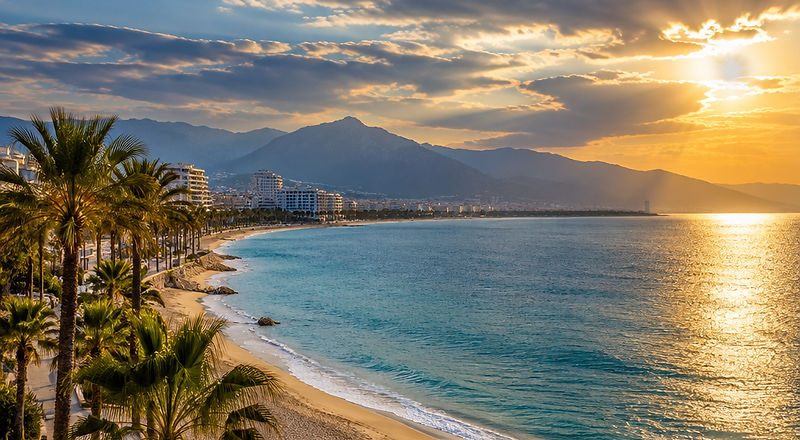
Costa del Sol Weather by Month: A Full Year of Sun and Rain
Costa del Sol weather by month: the full twelve-month cycle with monthly temperatures, rain and sea conditions, plus what a calima is and how to handle one.
The Costa del Sol did not get its name from a marketing department. With more than 300 days of sunshine a year and around 3,000 sunshine hours, the stretch of coast between Nerja and Sotogrande is one of the sunniest places in Europe, and the mountains behind it explain why. The Sierra de Malaga blocks much of the Atlantic weather that soaks western Andalusia, so while other provinces of Spain get drenched, the coast stays dry and bright for most of the year.
That is the short version. The long version is a twelve-month cycle with a real winter, a short but fierce summer, and one phenomenon nobody warns you about until the sky turns orange: the calima.
This is the full year on the Costa del Sol, month by month, with the numbers that matter, plus what a calima actually is, when it arrives and what to do when it does.
THE YEAR IN ONE PARAGRAPH
Rain falls on between 30 and 40 days a year, concentrated between October and March. Summer is effectively dry, with June, July and August recording close to zero rainfall. Sea temperatures run from about 16 degrees in winter to 23 or 24 in August. Daytime highs sit around 17 or 18 degrees in the coldest months and just over 31 in the hottest. What surprises most northern Europeans is not the summer, but the winter: bright, dry and mild, with cold nights.
THE MONTHS
January. Highs around 17 degrees, lows near 8. Sea temperature about 16. Mostly sunny, occasionally stormy, and the month when heating bills are real. Sunny afternoons of 17 to 19 degrees are common enough to have lunch outside.
February. Highs around 18, lows 9. One of the calmer months, and statistically one of the cloudiest, though a cloudy day here still means several hours of sun.
March. Highs 20 to 21, lows 10 to 11. The coast begins to warm before the sea does, so the beaches fill with walkers rather than swimmers. Rain becomes rarer as the month goes on.
April. Highs 22 to 23, lows 12. The most changeable month of spring: a day of 25 degrees can be followed by a day of rain and wind. Pack layers.
May. Highs 25 to 26, lows 15. Rainfall drops to roughly 35mm for the whole month, and the sea climbs towards 20. Locals call this the best month of the year, and they are right.
June. Highs 28 to 29, lows 18 to 19. Effectively dry. The sea crosses 21 and 22 degrees and the beach season starts in earnest.
July. Highs around 31, lows 22, sea 23. Rain close to zero, and daylight stretching past 14 hours. Heat inland of Malaga can top 40 degrees, while the coast stays a few degrees cooler thanks to the sea breeze.
August. Highs 31 to 32, lows 22, sea 23 to 24, the warmest of the year. Nights barely drop below 22. Everyone who can, heads for the mountains or the air conditioning.
September. Highs 28 to 29, lows 19 to 20, sea 22 to 23. The sea stays warm long after the air cools, which makes September the best swimming month. The first autumn storms sometimes appear at the end of the month.
October. Highs 24 to 25, lows 14 to 15, sea 20 to 21. Rain returns, typically 40 to 60mm across three to five wet days, and the landscape turns green almost overnight. Still mostly sunny.
November. Highs around 20, lows 12, sea about 19. One of the wettest months on the coast, with between 60 and 90mm of rain depending on the year. Expect dramatic storms alternating with warm sunny days.
December. Highs 17 to 18, lows 8 to 9, sea 16 to 17. The month of clear cold light. Sunny afternoons still reach the high teens, and the Christmas lights go up along the promenade.
CALIMA: WHAT IT IS
The calima is Saharan dust carried over the Mediterranean in warm air from Africa. When the wind blows from the south-east, it lifts fine dust from the desert and drops it over southern Spain. The result is unmistakable: the sky turns milky white or orange, the sun becomes a dim disc you can look straight at, visibility can drop to a few hundred metres, the air feels heavy and unusually warm, and a fine red layer of dust covers every parked car, terrace table and windowsill within a day.
Calima episodes last from a few hours to several days. Sometimes the dust arrives alone. Sometimes it arrives with rain, and then the rain falls as orange mud that stains cars, terraces and laundry hung out a few minutes too long.
WHEN IT ARRIVES
A calima can occur in any month. The episodes cluster when warm African air pushes over the coast, most often between February and June, and they can accompany summer heat bursts, when temperatures jump five degrees in a day and haze combines with heat alerts. The Spanish state weather agency, Aemet, issues yellow and orange alerts for both dust in suspension and the accompanying high temperatures, and those alerts are the earliest reliable signal that an episode is on its way.
WHAT TO DO WHEN IT ARRIVES
First, close the windows. The instinct is to open everything because the air feels warm. Do not. The dust is extremely fine and settles through an open window within hours.
Second, skip the outdoor exercise. Running, cycling and padel on a calima day mean breathing desert dust deep into the lungs. Train indoors or take the day off.
Third, wear a mask outdoors if the air visibly thickens. A standard FFP2 mask catches most of the particles. People with asthma, allergies or any respiratory condition should take this seriously, and the mask matters more for them than for anyone else.
Fourth, protect your eyes and rinse nose and mouth in the evening. Glasses or sunglasses help during the day, and a saline rinse removes most of what the day deposited.
Fifth, do not wash the car yet. An episode ends, the dust settles, and the next shower or the next car wash removes the red film. Washing mid-episode means washing twice.
Sixth, expect muddy rain. If rain is forecast with the dust, bring the cushions in, close the terrace blinds and get the car under cover if you can.
A CALIMA IS NOT A SANDSTORM
Television images of Saharan sandstorms have given the calima a reputation it does not deserve. There is no blowing sand on the Costa del Sol during an episode, no danger of being sandblasted and no reason to seal yourself indoors all day. It is dust in suspension, a few microns across, at a concentration that matters to your lungs and your car paint, not to your safety.
WHAT TO PACK, BY SEASON
From October to April: a jacket for the evenings, layers for the afternoons, and one umbrella. From May to September: sun cream, a hat and a bottle of water, plus something with sleeves for restaurants with air conditioning. All year round, sunglasses, because the light here is the point.
A LAST WORD ON AVERAGES
Every number above is an average, and averages on this coast vary more than the brochures admit. One November can pass with two storms and 90mm of rain; another delivers 60 and no storms at all. A February can produce a 24-degree afternoon or a windy day of 12. The pattern holds; the individual days do not. Check the Aemet forecast before you plan a trip, and check it again before you plan a beach day, because a calima or a rain system can change everything in six hours.
Related news

Costa del Sol Beaches Guide: The Best Sands Town by Town
Costa del Sol beaches guide: the best sand in every town from Nerja to Manilva, what the coloured flags mean, how water quality is checked and which beaches are accessible.


Spain Residency Guide: Types, Renewal Rules and Deadlines
Spain residency in 2026: NIE vs residencia, the EU green certificate, the TIE card, non-lucrative and digital nomad income thresholds, and the 60-day renewal window under Royal Decree 1155/2024.

Golden Visa Spain 2026: Status and the Alternatives Now
Golden Visa Spain closed on 3 April 2025. What existing holders keep, and the 2026 alternatives: the non-lucrative visa at 28,800 euros a year and the digital nomad visa.
Free Guide: Buying Property in Spain 2026
A step-by-step guide for international buyers — from NIE to the notary.
We'll send you the guide link by email too. No spam — your details stay with Marbella New Homes.